


Dr. Preet Pal SB, MD
Physician specializing in diabetes, metabolic health, and joint care management. Read More About Dr. Preet Pal’s Medical Credentials & Editorial Integrity Here
If your knees or hands predict an incoming rainstorm faster than your favorite weather app, you are not imagining it. Millions of adults experience heightened stiffness and aching whenever cold fronts roll in or atmospheric pressure drops. Doing gentle joint pain worse during weather changes exercises helps flush out built-up fluid, maintain flexibility, and keep your body moving comfortably no matter what the barometer says.
When barometric pressure falls, the air pressing against your body decreases. This pressure change allows sensitive, inflamed joint tissues to expand slightly, pressing against hyper-sensitive nerve endings. Performing targeted movements keeps synovial fluid circulating and prevents rigid stiffness from settling into your joints.
Quick-Relief Movement Routine
To counteract barometric stiffness and reduce pain during sudden weather shifts, perform this 5-step movement routine 1 to 2 times daily:
Why Barometric Shifts Trigger Pain & How Joint Pain Increase During Weather Change Happens
Think of your joint capsules like sealed, flexible balloons. Under high atmospheric pressure, the air outside keeps the balloon compact and tight. But when a cold front approaches and barometric pressure drops, the external push decreases. The balloon expands slightly.
If your joints are healthy, this tiny expansion goes completely unnoticed. However, if you have worn cartilage or localized inflammation, that expansion pushes swollen tissues directly against sensitive pain receptors.
Dr. Preet Pal’s Clinical Perspective
“Patients often ask me why their joints ache right before it rains, long before the cold air actually touches their skin. It is the barometric drop, not just the temperature, that causes soft tissues to swell. When tissue expands inside a rigid joint space, internal pressure spikes. Gentle movement acts like a manual pump, clearing inflammatory debris and keeping joint cartilage lubricated when atmospheric pressure works against you.”
Understanding how does weather affect joint stiffness is the first step toward reclaiming your mobility. When you combine internal pressure changes with cooler temperatures, synovial fluid—the natural oil inside your joints—thickens, making movement feel sticky and resistive.
Comparing Weather Triggers & Physical Responses
| Weather Trigger | Primary Biological Mechanism | Typical Affected Joints | Best Immediate Relief Strategy |
| Dropping Barometric Pressure | Tissue expansion against nerve endings | Knees, hips, lower back | Gentle range-of-motion circles |
| Temperature Drops | Synovial fluid thickening (gelation) | Fingers, wrists, toes | Moist heat therapy & warm-up moves |
| High Relative Humidity | Increased swelling perception | Ankles, knees, elbows | Low-impact aquatic movement |
7 Targeted Exercises for Weather-Related Joint Pain
These low-impact movements are designed specifically for days when rain, snow, or sudden cold fronts leave your body feeling tight and locked up.
1. Seated Pendulum Swings
Sit on the edge of a sturdy chair or high bed so your legs dangle freely. Gently swing your lower legs back and forth like a pendulum for 60 seconds.
This unweighted movement gently distributes synovial fluid across the cartilage without grinding the joint surfaces together.
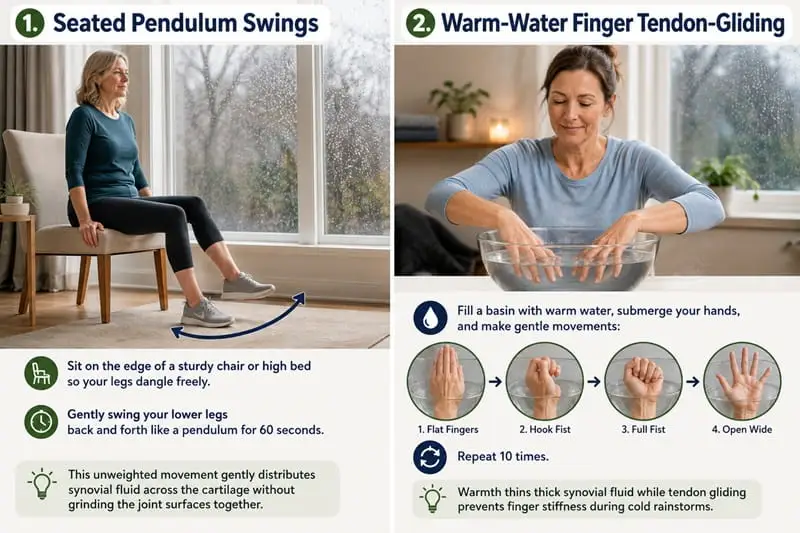
2. Warm-Water Finger Tendon-Gliding
Fill a basin with warm water, submerge your hands, and make gentle movements: start with flat fingers, curl into a hook fist, then a full fist, and open wide. Repeat 10 times.
Warmth thins thick synovial fluid while tendon gliding prevents finger stiffness during cold rainstorms.
5-Step Weather-Shift Mobility Routine
Follow this sequence to restore joint lubrication during barometric drops:
3. Isometric Quadriceps Sets
Lie flat on your back or sit upright with your legs extended. Tighten the muscle on top of your thigh by pressing the back of your knee flat into the floor. Hold for 5 seconds, relax, and repeat 10 times.
If you find that your joint pain is worse in cold weather, isometric exercises build stability without causing friction inside the joint.
4. Supine Hip Rotations (Windshield Wipers)
Lie on your back with knees bent and feet flat on the floor, wider than hip-width apart. Slowly drop both knees to the left, return to center, and drop them to the right. Repeat 8 times per side.
This opens tight hip capsules, relieving the tension that builds up when you hunch against the cold.
5. Standing Wall Push-Offs
Stand an arm’s length away from a wall. Place your palms flat at chest height. Bend your elbows to bring your chest toward the wall, then push back smoothly. Perform 10 reps.
This strengthens wrist, elbow, and shoulder joints without putting heavy weight on them.
6. Seated Torso Twists
Sit tall in a chair with feet flat. Inhale deeply, and as you exhale, gently twist your torso to the right, holding the chair arm for support. Hold for 10 seconds, return to center, and repeat to the left.
Mobilizing the spine helps maintain circulation along nerve pathways that travel down into your hips and legs.
7. Gentle Overhead Arm Reaches
In a comfortable seated or standing position, inhale as you reach both arms up toward the ceiling. Exhale as you lower them slowly to your sides. Perform 8 slow sweeps.
This keeps thoracic tissues supple on damp, high-humidity days.
Managing Seasonal Joint Flares
Exercise is your primary tool, but combining movement with smart lifestyle adjustments gives you complete weather protection.
- Layer Warm Clothing: Keep knees, hands, and wrists covered before stepping into cold air to keep synovial fluid thin.
- Stay Hydrated: Drinking water maintains the volume and cushion of joint fluid, even in winter when you feel less thirsty.
- Use Thermal Therapy: Apply a moist heating pad for 10 minutes before exercising to warm up stiff tissues.
Many people notice that do your joints hurt more in cold weather because they naturally stop moving and stay indoors. Keeping up a gentle indoor routine breaks that painful cycle.
Clinical Insight: Restoring Synovial Fluid Cushioning Naturally
While movement keeps joint fluid circulating, your body also needs the right raw nutrients to maintain its protective thickness—especially during drastic weather shifts. Age and barometric changes deplete hyaluronan, the molecule responsible for holding water inside your joint cartilage.
Dr. Preet Pal Notes: “Topical gels offer temporary relief, but systemic joint health depends on your synovial fluid quality. Formulations like Joint Genesis utilize advanced ingredients like Mobilee®—a patented hyaluronan complex—to re-hydrate dried-out joint cartilage. Replenishing this cushion calms deep tissue inflammation, allowing your joints to absorb impact comfortably even when atmospheric pressure drops.”
Protecting Your Joints Year-Round
A sudden barometric shift or cold snap does not have to stall your day. By moving through low-impact exercises, keeping your body warm, and supporting your cartilage from the inside out, you can handle seasonal weather changes with confidence.
Listen to your body, move smoothly without forcing through sharp pain, and keep your joints lubricated all year long.
Verified Medical Sources
- Tufts University School of Medicine – Barometric Pressure and Arthritis Pain Relationship Study: https://www.tufts.edu/
- Mayo Clinic – Joint Pain Triggers & Cold Weather Impact Guide: https://www.mayoclinic.org/diseases-conditions/arthritis/in-depth/arthritis/art-20047971
- Arthritis Foundation – How Weather Affects Joint Health & Exercise Strategies: https://www.arthritis.org/health-wellness/healthy-living/managing-pain/joint-pain/weather-and-joint-pain
- National Institute of Arthritis and Musculoskeletal and Skin Diseases (NIAMS) – Living with Osteoarthritis and Staying Active: https://www.niams.nih.gov/health-topics/osteoarthritis
Author Bio
Jennifer Collins is a wellness researcher and natural health writer focused on adults over 40. With 3+ years of experience in digital health content, Jennifer specializes in making science-backed nutrition and lifestyle strategies easy to follow and apply.
Health Disclaimer
This content is for informational purposes only and is not intended to diagnose, treat, or cure any disease. Always consult your healthcare provider before making changes to your diet or health routine. This article may include affiliate links, which come at no extra cost to you.