
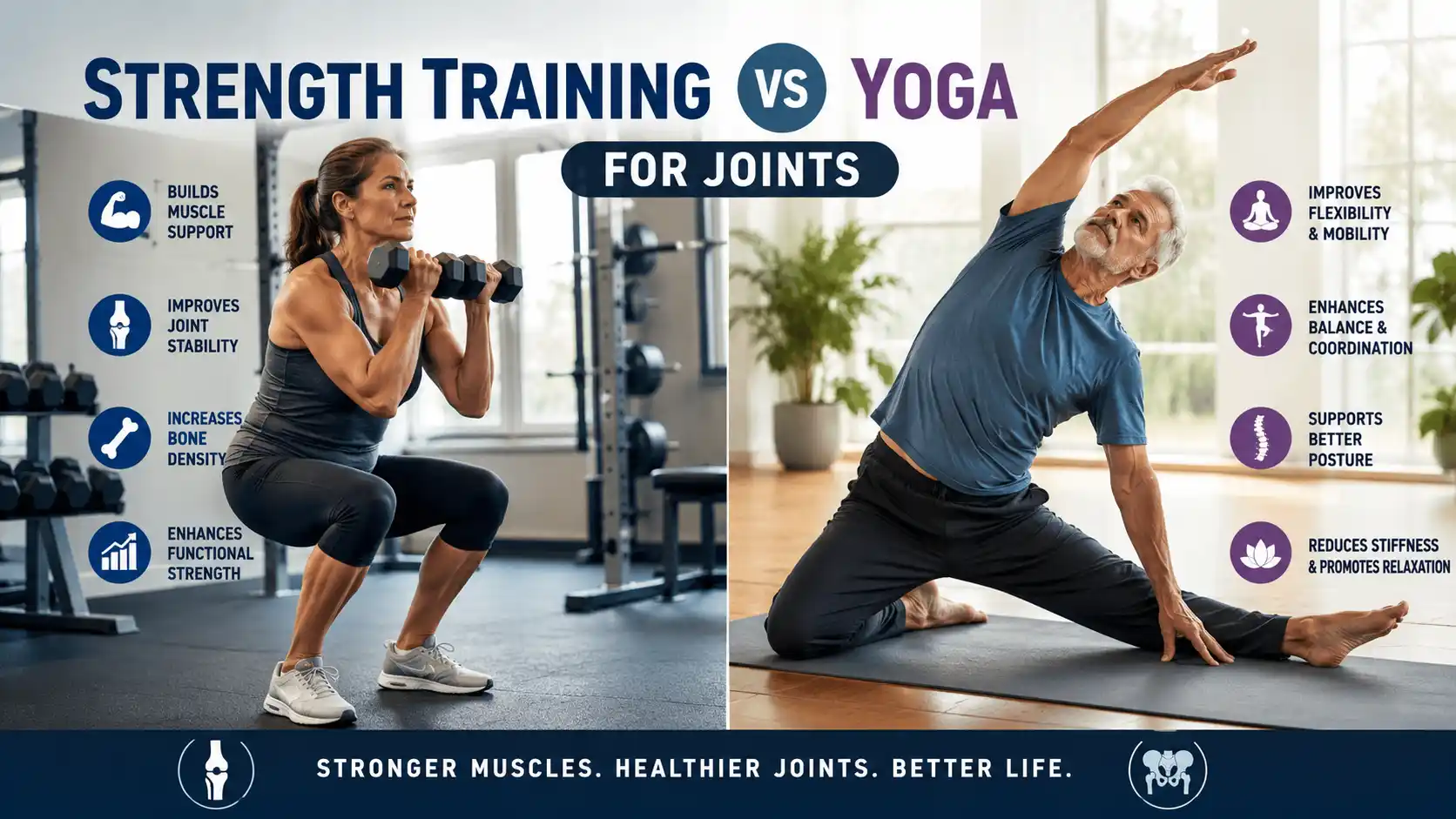
Joint stiffness, reduced mobility, and everyday aches become more common with age, especially after the age of 40. Knees may feel tighter in the morning, hips may lose flexibility, and shoulders can become less stable during simple tasks. Many people start searching for the best exercise routine that protects the body without causing more pain. This is where the discussion around strength training vs yoga for joints becomes important.
Both exercise styles offer meaningful benefits, but they work differently inside the body. Strength training focuses on building muscle, bone support, and stability around the joints. Yoga improves flexibility, mobility, balance, and body awareness through controlled movement and stretching. Research from trusted health organisations shows that both approaches can support healthy aging when done safely and consistently.
The real question is not whether one is completely better than the other. Instead, it is about understanding which method helps specific joint concerns, movement limitations, and lifestyle goals. For some people, resistance exercises may reduce joint pressure by improving muscle support. Others may benefit more from gentle mobility routines that ease stiffness and improve range of motion.
This article explores how both exercise styles affect aging joints, what science says about pain management and mobility, and how older adults can safely combine them for better long term health.
Why joints change with age
Aging affects nearly every structure inside the joints. Cartilage naturally becomes thinner over time, connective tissues lose elasticity, and muscles surrounding the joints gradually weaken. According to the Centers for Disease Control and Prevention, arthritis remains one of the leading causes of disability among older adults. Reduced physical activity often makes the problem worse because inactive joints become stiffer and less stable.
Joint pain does not always begin with damage alone. Muscle weakness, poor posture, excess body weight, and limited mobility can also increase stress on the knees, hips, spine, and shoulders. This explains why movement based therapies are now widely recommended for aging adults instead of prolonged rest.
Research from National Institute on Aging highlights that regular exercise helps preserve mobility, reduce inflammation related stiffness, improve circulation, and maintain independence later in life. The key is choosing exercises that improve function without placing excessive stress on sensitive joints.
Many adults searching for the best exercise for aging joints often assume that exercise must feel intense to be effective. In reality, controlled and consistent movement matters more than extreme workouts. Gentle but structured physical activity often delivers the greatest long term benefits for joint health.
Understanding strength training for aging joints
Strength training involves exercises that challenge muscles against resistance. This resistance may come from body weight, resistance bands, dumbbells, kettlebells, or machines. Contrary to outdated myths, properly supervised resistance training is considered safe for most older adults, including those with mild arthritis or reduced mobility.
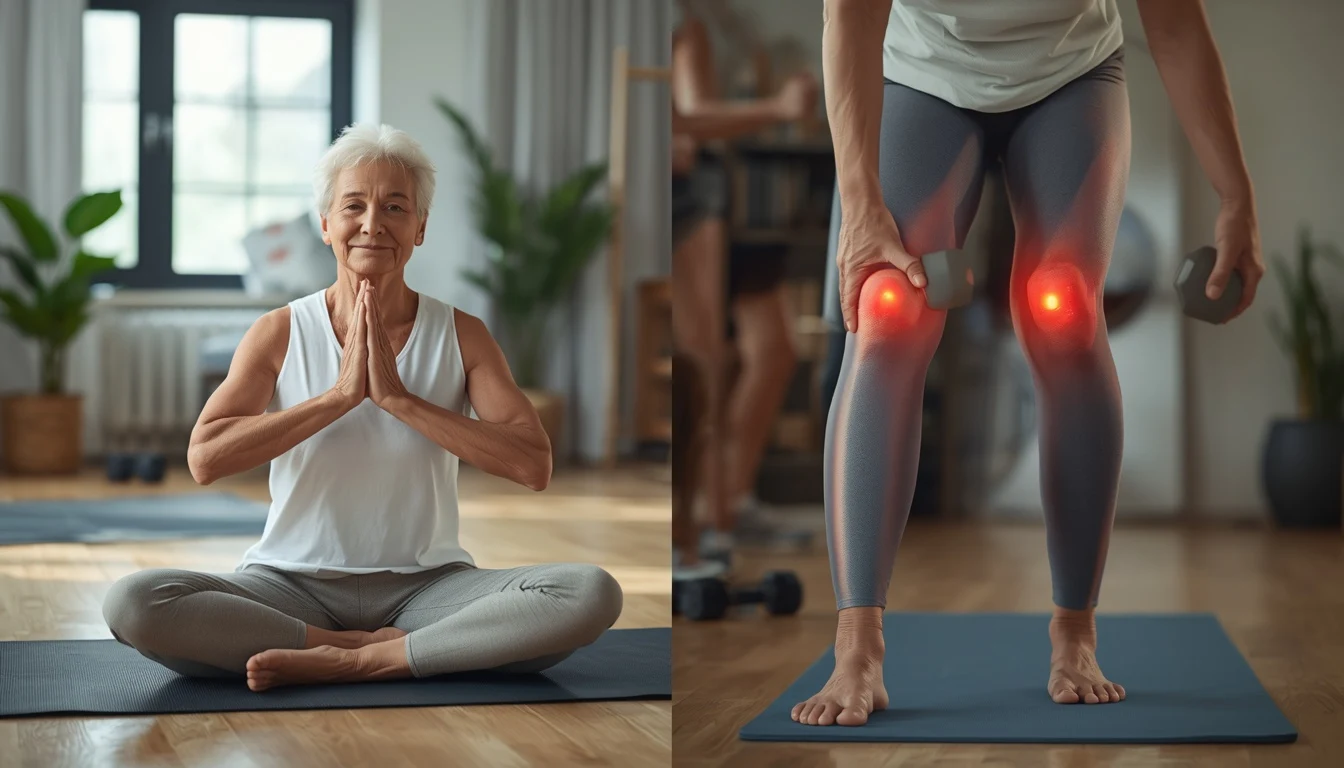
One major advantage of strength training is improved joint support. Strong muscles act like protective stabilisers around vulnerable joints. For example, stronger quadriceps muscles help reduce pressure on the knees during walking or climbing stairs. Similarly, stronger hip muscles improve balance and reduce instability during movement.
Studies published by the American College of Sports Medicine show that resistance training can improve physical function, reduce falls, and increase bone density in older populations. This becomes especially important because aging adults naturally lose muscle mass over time through a process called sarcopenia.
Strength exercises also help with metabolism and body composition. Carrying excess weight places additional pressure on the knees and lower back. Even moderate muscle development can improve calorie usage and reduce overall joint strain.
People comparing yoga or weight training for joint pain often overlook one important detail. Muscle weakness itself contributes to discomfort. Joints become less efficient when surrounding muscles cannot absorb physical stress properly. In these cases, targeted strengthening exercises may improve daily movement significantly.
Many physiotherapists now recommend strength exercises for aging adults because they improve muscle support, protect vulnerable knees and hips, and help maintain joint stability during daily activities. Controlled resistance exercises also contribute to better bone density, which becomes increasingly important for healthy aging. When older adults improve strength gradually, they often notice better walking confidence, reduced fatigue, and improved ability to perform normal household activities without discomfort.
Some highly effective low stress strength exercises for aging adults include:
Chair squats
Chair squats strengthen the hips, thighs, and glutes while supporting balance. They improve the ability to sit and stand independently.
Resistance band rows
These exercises strengthen the upper back and shoulders while improving posture and reducing neck tension.
Step ups
Controlled step movements improve knee stability and support walking confidence.
Wall push ups
This modified pushing exercise builds upper body strength without excessive wrist pressure.
For adults dealing with stiffness, resistance sessions should begin slowly with controlled form, proper breathing, and sufficient recovery time.
How yoga supports joint mobility and flexibility
Yoga focuses on mobility, flexibility, breathing control, posture, and mind body awareness. Unlike high intensity workouts, yoga usually emphasises slower movement patterns that encourage better joint motion and muscle relaxation.
One of yoga’s greatest advantages for aging adults is improved flexibility. Tight muscles around the hips, spine, and shoulders often limit movement and increase discomfort. Gentle stretching routines can help restore mobility gradually.
Research from Harvard Medical School suggests that yoga may improve flexibility, balance, sleep quality, and stress management in older adults. Certain yoga styles may also support mild pain relief by improving circulation and reducing muscular tension.
Balance is another important benefit. Falls remain a major health concern among older adults, especially those with poor coordination or weakened lower body muscles. Yoga poses challenge body awareness and balance control, which may help reduce fall risk over time.
When discussing strength training vs yoga for aging joints, yoga stands out for its ability to improve movement quality. Many adults experience stiffness not because of weakness alone, but because connective tissues become less mobile with age.
Yoga can also support mental health. Chronic pain often creates stress, frustration, and reduced activity levels. Controlled breathing exercises used during yoga may lower stress hormones and improve relaxation responses inside the body.
Yoga based mobility exercises are especially helpful for improving joint mobility and restoring natural movement patterns that become restricted with age. Gentle stretching encourages better circulation through muscles and connective tissues, while controlled breathing supports smoother movement quality. Many instructors also include balance training, posture improvement, and calming flexibility routines that support safer movement in everyday life for aging adults dealing with stiffness or reduced coordination.
Some joint friendly yoga poses include:
Cat cow stretch
Improves spinal mobility and reduces back stiffness.
Child’s pose
Gently stretches the hips and lower back while encouraging relaxation.
Mountain pose
Improves posture, body awareness, and standing alignment.
Supported warrior poses
Strengthen the legs while improving balance and hip mobility.
Many yoga instructors now offer specialised classes designed for seniors and individuals with arthritis. These programs often focus on safe modifications and slow transitions.
Strength training vs yoga for joints: Which works better?
The debate around strength training vs yoga for joints often creates unnecessary competition between two highly beneficial exercise styles. In reality, both approaches target different aspects of joint health.
Strength training primarily improves stability, muscle support, and bone strength. Yoga mainly improves flexibility, mobility, coordination, and movement efficiency.
Older adults dealing with muscle weakness and instability may benefit more initially from resistance training. People struggling with stiffness, reduced range of motion, or chronic tension may notice faster improvement with yoga based mobility exercises.
Scientific evidence increasingly suggests that combining both approaches provides the strongest overall outcomes for healthy aging. Resistance exercises help maintain structural support while yoga improves movement quality and recovery.
The answer also depends on specific conditions:
For osteoarthritis
Strength training often improves joint support and physical function. Yoga may help reduce stiffness and improve mobility.
For balance problems
Yoga provides excellent balance and coordination training, especially through standing poses and controlled transitions.
For bone density
Resistance training usually delivers stronger benefits because bones respond positively to mechanical loading.
For stress related muscle tension
Yoga often works better because breathing exercises calm the nervous system and reduce muscular guarding.
People searching for the best exercise for aging joints may achieve better results by combining both exercise styles instead of choosing only one.
Can exercise reduce joint pain naturally?
Physical inactivity may worsen joint discomfort over time. When muscles weaken and joints become less mobile, the body often compensates with poor movement patterns that increase stress.
According to the Arthritis Foundation, regular movement helps nourish cartilage, strengthen supporting muscles, and improve circulation around painful joints. Exercise may also reduce inflammation related stiffness in some individuals.
This does not mean all exercise is automatically safe. High impact activities involving repetitive pounding or twisting can aggravate already irritated joints. Aging adults often respond better to structured, progressive movement routines.
This is why many experts recommend low impact workouts for seniors with joint stiffness instead of aggressive training methods. Joint friendly exercises improve movement without overwhelming vulnerable tissues.
Walking, water aerobics, tai chi, yoga, and resistance band exercises all fall into this category. These exercises help maintain movement capacity while minimising unnecessary impact stress.
An important point often ignored in the discussion around yoga or weight training for age related joint pain is exercise consistency. Moderate exercise performed regularly usually works better than occasional intense workouts followed by long inactivity periods.
Experts frequently recommend joint friendly exercises for seniors because consistent low impact fitness activities can improve circulation, reduce muscle weakness, and support long term functional movement. Gentle activity programs may also assist with mild arthritis pain relief when combined with proper recovery and medical guidance. Many older adults benefit from combining walking, stretching, and recovery exercises into a sustainable senior fitness routine instead of relying on overly intense workouts that increase joint stress.
The role of flexibility and mobility in healthy aging
Flexibility and mobility are not identical concepts, although people often use them interchangeably. Flexibility refers to muscle length, while mobility describes how well a joint moves through its available range with control.
Healthy aging requires both.
A person may have flexible muscles but still struggle with controlled movement because of weakness or poor coordination. Similarly, strong muscles alone do not guarantee smooth joint function if stiffness limits movement.
Yoga improves mobility by encouraging joints to move through controlled ranges. Strength training can also improve mobility when exercises are performed with proper technique and full movement patterns.
For example, deep bodyweight squats improve hip and ankle mobility while strengthening the lower body simultaneously. Likewise, yoga poses such as downward dog improve shoulder mobility while gently strengthening the upper body.
Many physical therapists now integrate both flexibility training and resistance exercises into rehabilitation programs for older adults.
People exploring the best exercises for aging joints should remember that healthy movement involves balance between strength, flexibility, coordination, and endurance.
Common mistakes older adults make during exercise
Even beneficial exercise can become harmful if performed incorrectly. Many older adults unintentionally increase joint stress because of poor technique or unrealistic expectations.
Exercising through sharp pain
Mild soreness can be normal during exercise adaptation. Sharp or worsening joint pain is not. Persistent pain signals the need for exercise modification.
Skipping warm ups
Cold muscles and stiff joints respond poorly to sudden movement. Gentle mobility exercises before workouts improve circulation and reduce injury risk.
Progressing too quickly
Many adults increase resistance or intensity too fast. Joints often need more recovery time with age.
Ignoring posture
Poor posture during lifting or stretching increases stress on vulnerable joints.
Avoiding movement completely
Fear of pain sometimes leads people to stop exercising entirely. Unfortunately, inactivity often worsens stiffness and weakness.
Safe movement progression matters more than exercise intensity for aging adults.
Building a balanced joint friendly routine
A balanced weekly routine often works better than relying on one exercise method alone.

An ideal schedule may include:
Strength training two to three times weekly
Focus on major muscle groups using controlled movements and moderate resistance.
Yoga or mobility sessions two to four times weekly
Emphasise flexibility, breathing, posture, and balance.
Walking or low impact cardio
Steady walking supports circulation, heart health, and endurance without excessive joint stress.
Recovery days
Recovery helps muscles and connective tissues adapt properly.
Adults interested in low impact workouts for seniors with joint stiffness should prioritise sustainability instead of intensity. The best exercise program is the one that remains realistic long term.
Nutrition and hydration also affect joint health
Exercise alone cannot fully support joint health without proper nutrition and hydration.
Protein supports muscle repair and maintenance, especially important during aging. Calcium and vitamin D contribute to bone health, while omega 3 fatty acids may support inflammatory balance.
Hydration matters because connective tissues and cartilage rely on water for lubrication and shock absorption.
According to the Mayo Clinic, maintaining a healthy body weight also reduces pressure on weight bearing joints like the knees and hips.
Healthy lifestyle habits combined with regular movement create stronger long term outcomes than exercise alone.
When to speak with a healthcare professional
Some joint symptoms require medical evaluation before starting new exercise routines.
Seek professional guidance if you experience:
Severe swelling
Persistent swelling may indicate inflammation or injury.
Sudden instability
Frequent buckling or loss of balance needs assessment.
Sharp pain during movement
Pain that worsens with exercise should not be ignored.
Recent surgery or fractures
Exercise plans should be adjusted carefully after major medical procedures.
Physical therapists, rheumatologists, and sports medicine professionals can help create safe exercise strategies tailored to specific conditions.
Conclusion
The discussion around strength training vs yoga for joints should not focus on choosing a single winner. Both forms of exercise offer valuable but different benefits for aging adults.
Strength training improves muscle support, stability, bone density, and functional independence. Yoga enhances flexibility, mobility, posture, relaxation, and movement quality. Together, they create a more complete foundation for healthy aging.
People searching for the best exercises for aging joints often discover that balanced movement routines work better than extreme fitness trends. Consistency, proper technique, and gradual progression matter far more than workout intensity.
Also Read: Joint Genesis vs Flexafen 2026: Which Joint Supplement Works Better?
For individuals comparing yoga or weight training for joint pain, the best choice may depend on current mobility, strength levels, pain patterns, and personal comfort. Many adults achieve the greatest improvement by combining resistance exercises with gentle mobility work.
Finally, sustainable movement habits remain one of the most effective ways to support long term joint health. Even simple low impact exercises for seniors with joint stiffness can improve daily function, confidence, and quality of life when practised consistently.
Sources
Centers for Disease Control and Prevention
National Institute on Aging
American College of Sports Medicine
Harvard Medical School
Arthritis Foundation
Mayo Clinic
FAQs
Are resistance bands effective for joint friendly strength exercises?
Resistance bands are highly effective for older adults because they provide controlled resistance without placing excessive pressure on sensitive joints. Unlike very heavy weights, bands allow smoother movement patterns that improve muscle activation while reducing unnecessary stress on the knees, shoulders, and hips. They are especially useful for beginners who want safer strength progression at home. Resistance band routines also improve coordination and support daily movement tasks such as standing, climbing stairs, and carrying objects. When used consistently with proper form, they can become an excellent long term addition to a joint conscious fitness routine.
Can mobility training improve walking balance in older adults?
Mobility training can significantly improve balance and walking efficiency in older adults because it helps joints move more smoothly and predictably. Restricted ankle, hip, or spinal movement often changes posture and walking mechanics, increasing instability during daily activities. Controlled mobility exercises improve coordination, body awareness, and movement confidence over time. Better joint motion also allows muscles to respond more effectively when the body needs quick balance corrections. Many physiotherapists now include mobility focused exercises in fall prevention programs because improved movement control supports safer walking patterns and greater independence.
Do flexibility exercises help morning stiffness?
Flexibility exercises may help reduce morning stiffness by increasing circulation and gently warming muscles and connective tissues after long periods of inactivity during sleep. Aging joints often become tighter overnight because movement decreases for several hours. Slow stretching and controlled mobility work help restore comfortable movement without sudden strain. Consistent flexibility practice may also improve posture and reduce muscular tension that contributes to stiffness around the hips, neck, shoulders, and lower back. Best exercise for aging joints, like gentle morning stretching routines are usually more effective when performed regularly instead of only during pain flare-ups.
Is bodyweight training safer than heavy lifting for seniors?
Yoga or weight training for joint pain is often considered safer for many older adults because it allows people to strengthen muscles using controlled movement without immediately handling heavy external loads. Exercises such as chair squats, wall push ups, and step ups improve coordination, balance, and lower body strength while reducing injury risk. However, safety depends more on technique, supervision, and progression than the type of exercise alone. Some seniors may eventually benefit from moderate resistance training once movement quality improves. Starting slowly and focusing on proper form usually creates better long term outcomes for joint health.
How does posture affect joint stress?
Posture affects how force travels through the body during standing, walking, lifting, and sitting. Poor posture changes alignment and can place uneven pressure on the spine, hips, knees, and shoulders over time. For example, rounded shoulders and forward head posture may increase tension in the neck and upper back, while poor hip alignment can affect knee movement. Good posture improves movement efficiency and allows muscles to support joints more evenly. This reduces unnecessary strain on vulnerable areas and may help improve comfort during daily physical activities, especially in older adults with existing stiffness.
Why is recovery important for aging muscles and joints?
Recovery becomes increasingly important with age because muscles, tendons, and joints often require more time to adapt after physical activity. Without proper recovery, the body may remain inflamed or fatigued, increasing the risk of soreness and overuse injuries. Recovery allows muscle tissues to rebuild and helps joints tolerate movement more comfortably over time. Good recovery habits include sleep, hydration, balanced nutrition, stretching, and alternating intense days with lighter activity. Older adults who ignore recovery frequently experience setbacks that make exercise harder to maintain consistently over the long term.
Can balance exercises help reduce fall risk?
Balance exercises and low impact workouts for seniors with joint stiffness may help reduce fall risk because they train coordination, body awareness, and lower body control during movement. Aging often affects reaction speed and joint stability, making sudden movements more difficult to manage safely. Balance focused activities teach the body how to respond more effectively to uneven surfaces, quick direction changes, or temporary instability. Exercises such as single leg standing, controlled yoga poses, and slow stepping drills improve confidence and coordination gradually. Consistent balance practice may also support safer walking patterns and help older adults remain more independent in daily life.
Author Bio
Jennifer Collins is a wellness researcher and natural health writer focused on adults over 40. With 3+ years of experience in digital health content, Jennifer specializes in making science-backed nutrition and lifestyle strategies easy to follow and apply.
Health Disclaimer
This content is for informational purposes only and is not intended to diagnose, treat, or cure any disease. Always consult your healthcare provider before making changes to your diet or health