


Dr. Preet Pal SB, MD
Physician specializing in diabetes, metabolic health, and joint care management. Read More About Dr. Preet Pal’s Medical Credentials & Editorial Integrity Here
Joint pain changes how you move, sit, and even sleep. That is why many people search for natural solutions like collagen. But one big question keeps coming up: collagen for joints does it work, or is it just another health trend?
Let’s break this down with real science, clear logic, and practical advice you can actually use.
How Collagen Interacts with Joint Cartilage
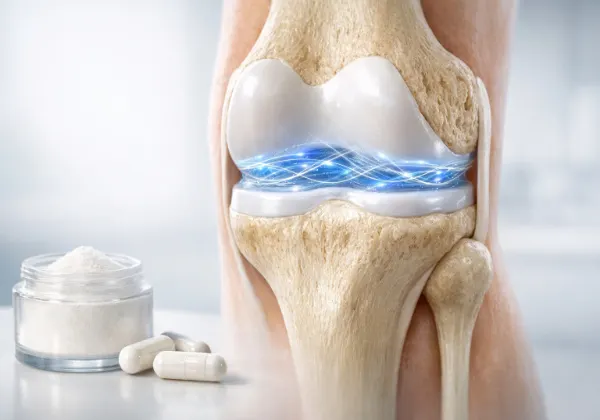
When ingested, hydrolyzed collagen peptides pass through the gut barrier and accumulate in joint cartilage, stimulating chondrocytes (cartilage cells) to synthesize new extracellular matrix proteins and extracellular collagen.
What Science Confirms vs. What It Doesn’t
Clinical trials show 5g–10g daily of hydrolyzed collagen peptides or 40mg of Undenatured Type II Collagen (UC-II) significantly reduces joint stiffness and pain. However, it does not fully “regrow” lost cartilage in severe osteoarthritis.
Realistic Results Framework
Noticeable pain reduction and improved range of motion typically require 8 to 12 weeks of daily, uninterrupted compliance. Maximum functional benefits manifest between 12 and 24 weeks.
Table of Contents
What Is Collagen and Why Does It Matter for Joints?
Collagen is the most abundant protein in your body. It plays a key role in your skin, bones, tendons, and cartilage. Think of it as the structural glue that holds your joints together.
Your cartilage relies heavily on collagen, especially Type II collagen. This type helps maintain flexibility and shock absorption in your joints.
As you age, collagen production drops. This decline often starts in your 30s and speeds up after 40. That is when stiffness, joint pain, and reduced mobility start to show up.
So the idea behind collagen supplements sounds simple. Replace what your body is losing and support joint health.
But here is the real question. Collagen for joints does it work when you take it as a supplement?
How Joint Cartilage Actually Works
Before we answer that, you need to understand cartilage.
Cartilage is a smooth, rubber-like tissue that covers the ends of bones. It allows joints to move without friction. It also absorbs shock during movement.
Here is the catch. Cartilage has very limited ability to repair itself. It does not have a direct blood supply. That makes healing slow and difficult.
So when cartilage breaks down, especially in conditions like osteoarthritis, the body struggles to rebuild it.
That is why the claim that collagen can rebuild cartilage sounds appealing. But is it accurate?
Collagen for Joints Does It Work According to Science?
Let’s look at what research actually says.
Several clinical studies show that collagen supplements can improve joint pain and function. For example, a study published in Current Medical Research and Opinion found that people taking collagen hydrolysate experienced reduced joint discomfort compared to placebo.
Another study in the International Journal of Medical Sciences showed that collagen supplementation improved symptoms in people with osteoarthritis.
However, here is the important part. These studies show symptom improvement, not full cartilage regrowth.
So when people ask, collagen for joints does it work, the honest answer is:
It can help reduce pain and improve joint function, but it does not rebuild cartilage completely.
Dr. Preet Pal’s Clinical Perspective
“When patients ask me if collagen can ‘rebuild’ their cartilage, I always clarify the distinction between structural regeneration and cellular signaling. Collagen peptides don’t simply float into your joint space and instantly stick to raw bone. Instead, small bioactive peptides act as biological signals that tell your body’s chondrocytes to produce more native Type II collagen and proteoglycans. It is an enzymatic catalyst for repair rather than a direct physical patch.”

What Happens When You Take Collagen?
When you consume collagen, your body breaks it down into amino acids during digestion. These amino acids then get used wherever your body needs them.
Some research suggests that collagen peptides may stimulate cartilage cells called chondrocytes. These cells help maintain cartilage structure.
This means collagen may support repair processes, but it does not act like a direct “cartilage builder.”
So again, collagen for joints does it work depends on your expectations. It supports joint health, but it is not a miracle fix.
Types of Collagen That Help Joints
Not all collagen works the same.
Type I Collagen
This type supports skin, bones, and tendons. It helps overall structure but does not directly target cartilage.
Type II Collagen
This is the most important type for joints. It makes up a large portion of cartilage and supports joint cushioning.
Collagen Peptides (Hydrolyzed Collagen)
These are broken-down forms that your body absorbs easily. Many studies use this form for joint support.
If you want real results, focus on supplements that include Type II collagen or hydrolyzed collagen.
Collagen vs Other Joint Supplements
People often compare collagen with glucosamine and chondroitin.
Glucosamine supports cartilage structure. Chondroitin helps retain water in cartilage. Collagen provides the building blocks.
Some studies suggest combining these may offer better results than using one alone.
Still, when asking collagen for joints does it work, remember that it works best as part of a broader approach, not in isolation.
How Long Does Collagen Take to Work?

Collagen is not a quick fix. Your body needs time to respond.
Most studies show noticeable improvements in:
- 8 to 12 weeks for reduced joint pain
- 12 to 24 weeks for improved joint function
Consistency matters more than dosage spikes.
If you stop too early, you may not see results.
Collagen takes time to show results, but combining it with faster-acting options like those explained in Turmeric for Joint Pain Dosage: Best Amount, Forms & Results That Work may improve overall joint comfort.
Best Dosage for Joint Support
Research-backed doses usually fall between:
- 5 grams to 10 grams of collagen peptides daily
For Type II collagen, smaller doses like 40 mg are often used because it works differently.
Taking collagen with vitamin C may help your body produce collagen more effectively.
Who Benefits the Most from Collagen?
Collagen works best for:
People with mild to moderate joint pain
Older adults with age-related stiffness
Athletes with joint stress
People in early stages of osteoarthritis
If your joint damage is severe, collagen alone may not be enough.
Common Myths About Collagen
Myth 1: Collagen rebuilds cartilage completely
This is not supported by strong evidence. It supports but does not fully rebuild.
Myth 2: More collagen means faster results
Your body can only use a certain amount. Taking more does not speed things up.
Myth 3: Collagen works instantly
Joint improvement takes weeks, not days.
Side Effects and Safety
Collagen is generally safe for most people.
Some may experience:
- Mild bloating
- Digestive discomfort
- Feeling of fullness
Always choose high-quality products tested for purity.
How to Maximize Results
You cannot rely only on supplements.
To get better outcomes:
Stay active with low-impact exercise
Maintain a healthy weight
Eat a balanced diet rich in protein and vitamins
Stay consistent with supplementation
These habits work together with collagen to support your joints.
Collagen for Joints Does It Work in Real Life?
Let’s keep it real.
If you expect collagen to rebuild cartilage like new, you will be disappointed.
If you use it to reduce pain, support joint function, and improve mobility over time, you will likely see benefits.
That is why the question collagen for joints does it work has a balanced answer.
Yes, it works for support and symptom relief. No, it does not completely reverse joint damage.
Frequently Asked Questions
Does collagen really help joint pain or is it a myth?
Collagen for joints does it work is a common question, and research shows it can help reduce joint pain and improve mobility over time. While it does not fully rebuild cartilage, collagen provides essential amino acids that support joint structure and reduce inflammation-related discomfort.
How long does collagen take to work for joints?
When people ask collagen for joints does it work, timing matters. Most studies show noticeable improvements in joint pain within 8 to 12 weeks of daily use. Consistency plays a key role in achieving results.
Can collagen rebuild cartilage in joints?
Collagen for joints does it work depends on expectations. Collagen does not fully rebuild damaged cartilage, but it may support cartilage maintenance and slow further breakdown by stimulating cartilage cells and improving joint health.
What is the best type of collagen for joint health?
If you are wondering collagen for joints does it work, choosing the right type matters. Type II collagen is best for joints because it directly supports cartilage, while hydrolyzed collagen peptides improve absorption and overall joint function.
Is it safe to take collagen every day for joints?
Yes, collagen is generally safe for daily use. For those asking collagen for joints does it work, regular intake of 5 to 10 grams of collagen peptides per day is commonly used in studies and considered effective for long-term joint support.
Final Thoughts
Collagen is not magic, but it is not useless either.
It offers a practical, science-backed way to support joint health when used correctly.
The key lies in realistic expectations, consistent use, and combining it with healthy habits.
If you approach it the right way, collagen can become a valuable part of your joint care routine.
Sources
- Clark KL, Sebastianelli W, Flechsenhar KR, et al.
- Martínez-Puig D, et al.
- National Institutes of Health (NIH), Office of Dietary Supplements
These sources include peer-reviewed research and trusted health organizations to ensure accuracy and credibility.
These sources provide reliable, research-based information on arthritis, joint care, and hand health.
Author Bio
Jennifer Collins is a wellness researcher and natural health writer focused on adults over 40. With 3+ years of experience in digital health content, Jennifer specializes in making science-backed nutrition and lifestyle strategies easy to follow and apply.
Health Disclaimer
This content is for informational purposes only and is not intended to diagnose, treat, or cure any disease. Always consult your healthcare provider before making changes to your diet or health routine. This article may include affiliate links, which come at no extra cost to you.