

Dr. Preet Pal SB, MD
Physician specializing in diabetes, metabolic health, and joint care management. Read More About Dr. Preet Pal’s Medical Credentials & Editorial Integrity Here
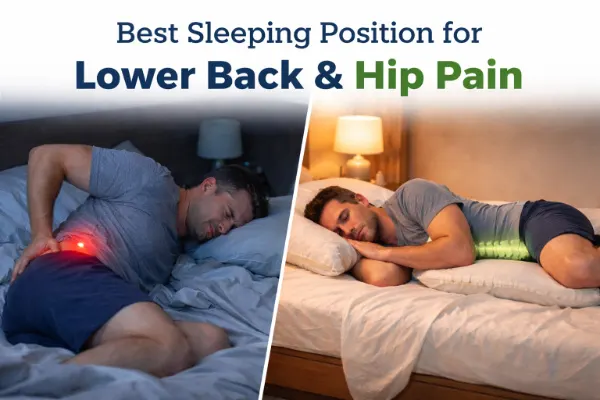
Waking up with a throbbing lower back or stiff, aching hips turns every morning into a physical struggle. If you spend your nights tossing, turning, and searching for a position that does not trigger sharp joint tension, your biomechanics are out of sync. Finding the best sleeping position for lower back and hip pain is not just about comfort—it is about restoring neutral spinal alignment so your neuromuscular system can recover overnight.
Table of Contents
When your posture collapses during sleep, your spine twists, straining deep lumbar ligaments and putting prolonged mechanical stress on the hip socket. Understanding how posture affects your joints—especially if you suffer from hip pain when sleeping on side after 50—is the first step toward waking up pain-free.
Side Sleeping with a Firm Knee Pillow
Lie on your uninjured side with your knees slightly bent. Place a firm pillow between your knees and ankles to keep your hips, pelvis, and lumbar spine in a straight, neutral plane.
Back Sleeping with Knee Elevation
Lie flat on your back and place a bolster or two firm pillows beneath your knees. This flattens the lumbar curve slightly, taking direct pressure off the facet joints and lower back muscles.
Fetal Position with Contoured Support
Tuck your knees gently toward your chest while lying on your side. This opens the intervertebral spaces, reducing compressive force on herniated discs and pinched spinal nerves.
Why Your Sleeping Posture Triggers Nighttime Joint Pain
Think of your spine like a high-performance suspension bridge. The vertebrae are the structural pillars, while your deep core muscles, tendons, and ligaments act as tension cables holding everything balanced. When you sleep in a twisted or sagged posture, one side of those suspension cables stretches beyond its natural threshold while the other side contracts.
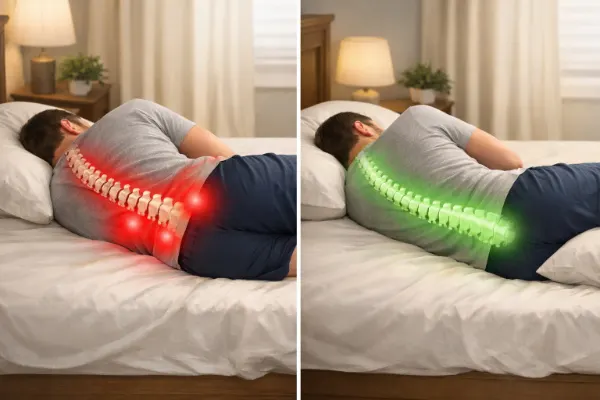
Over an eight-hour night, this sustained muscular compensation starves joint tissue of vital fluid exchange. The lumbar discs and hip cartilage rely on a “sponge-like” pumping motion during movement to stay hydrated. Prolonged biomechanical strain locks the joints in a compressed state, leading to stiffness, micro-inflammation, and acute morning pain. Identifying the underlying root cause is critical—many adults over 40 misread early warnings, missing the most common joint pain causes after 40 until structural degradation sets in.
The Best Sleep Position for Hips and Back: Clinical Breakdown
Optimizing the best sleep position for hips and back requires aligning the spinal column from the atlas cervical vertebra down to the sacrum. Below is a detailed biomechanical breakdown of how to configure each position for maximum pressure relief.
| Sleeping Position | Spinal Impact | Hip Impact | Best Clinical Application |
|---|---|---|---|
| Side + Knee Pillow | Maintains neutral lateral curve | Prevents pelvic rotation & adduction | Sciatica, Bursitis, Hip Impingement |
| Back + Knee Elevation | Reduces lumbar lordotic stress | Equalizes bilateral joint force | Herniated Discs, Facet Joint Strain |
| Modified Fetal | Widens intervertebral foramina | Reduces direct trochanteric stress | Spinal Stenosis, Disc Bulges |
| Stomach (Unassisted) | Creates hyper-lordosis & torsion | Forces anterior pelvic tilt | NOT Recommended (High Joint Strain) |
1. Side Sleeping with Elevated Knee Support
Side sleeping is widely regarded as the most effective posture for spinal alignment, provided you use proper cushioning. When you lie on your side without support, your top leg drops forward, torqueing your pelvis and pulling the lower lumbar vertebrae out of line.
How to optimize: Place a firm, contoured pillow between your knees and lower legs. The pillow must extend down to your ankles to keep your legs parallel, preventing pelvic rotation.
2. Back Sleeping with Lumbar Decompression
Back sleeping evenly distributes body weight across your frame, eliminating high-pressure points. However, sleeping flat on your back without knee support causes the psoas muscle to pull on the lower spine, arching your lower back away from the mattress.
How to optimize: Slide a medium bolster under your knees. Elevating the knees flexes the hip joints slightly, flattening the lumbar spine against the mattress and relaxing the erector spinae muscles.
Dr. Preet Pal’s Clinical Perspective
“In my clinical practice, patients often assume their morning stiffness is purely an arthritic issue. In reality, it is frequently exacerbated by nocturnal mechanical stress. When you lie twisted for hours, you are essentially holding a passive joint stretch past its anatomical limit. For patients struggling with chronic spinal or hip joint inflammation, combining proper posture with nocturnal joint support is essential for true overnight cellular recovery.”
Dangerous Sleeping Positions You Should Avoid
If you suffer from chronic lower back or hip discomfort, certain sleeping habits actively worsen tissue degradation.
The Stomach Sleep Torsion Trap
Stomach sleeping is the most destructive posture for spinal health. To breathe while lying flat on your stomach, you must turn your neck 90 degrees for hours at a time, introducing severe rotation into the upper cervical spine that radiates down the entire spinal chain.
Simultaneously, stomach sleeping forces the lower back into hyper-lordosis (an exaggerated arch), compressing the posterior facet joints and sinking the pelvis into the mattress. This subjects the hip capsule to constant anterior pressure.
The Half-Twisted “T-Rex” Position
Lying half on your side and half on your stomach with one leg hitched up toward your chest acts like a continuous wrenching force on your sacroiliac (SI) joint. This creates asymmetrical strain on the gluteus medius tendons and sciatic nerve, leading to sharp, shooting pains down the leg upon waking.
Mattress and Pillow Biomechanics: The Support Matrix
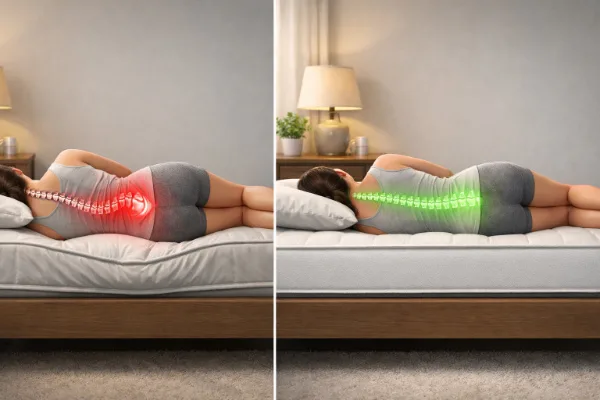
Even the best sleeping position for lower back and hip pain will fail if your mattress creates sagging pressure zones.
- Medium-Firm Rating (6.0–7.0/10): Clinical trials consistently demonstrate that medium-firm sleeping surfaces provide the optimal balance between surface contouring and structural support.
- The Tire Tread Analogy: Imagine driving a car on underinflated tires. The rubber sags at the edges, causing uneven tread wear and straining the axle. A mattress that is too soft acts like that underinflated tire—your hips sink too deep, forcing your spine to sag into an unnatural curve all night. Conversely, a rock-hard mattress fails to absorb shock, causing painful pressure points over the hip bone.
- Pillow Loft Selection: Side sleepers require a higher loft pillow (4 to 5 inches) to fill the gap between the neck and shoulder, while back sleepers need a medium loft (3 to 4 inches) to keep the head from being pushed forward.
If you are evaluating comprehensive strategies for full-body joint preservation, review our master guide on finding the best sleeping position for joint pain.
Targeted Sleep Optimization Strategies
Beyond changing your position, implementing a pre-bed biomechanical routine helps prepare your joints for rest:
Use Thermal Therapy: Applying 15 minutes of moist heat to the lower back or hips before bed dilates blood vessels, bringing nutrient-rich blood flow to fatigued muscular tissues.
Perform Deconstructive Stretches: Perform 60 seconds of gentle “Cat-Cow” maneuvers or a knee-to-chest stretch before getting into bed to unload compressed spinal discs.
Hydrate Strategic to Bedtime: Cartilage consists of roughly 80% water. Maintaining hydration ensures joint fluid retains its shock-absorbing viscosity throughout the night.

Targeted Night-Time Support: Calming Nocturnal Joint Inflammation
While perfecting your posture removes mechanical stress from your joints, mechanical alignment is only half the battle. If your joint capsule is actively inflamed from wear and tear, even the best sleeping position cannot completely prevent dull, deep-seated aching.
To achieve continuous relief, you must address the internal biochemical triggers of night-time inflammation. Advanced botanical formulations like Flexafen are designed to target joint tissue overnight. Flexafen incorporates bioavailable ingredients like Type II Collagen, Boswellia Serrata, and Hyaluronic Acid that work synergistically to soothe swollen synovial membranes and replenish joint fluid.
From a clinical standpoint, supporting tissue integrity internally while maintaining neutral posture externally creates the ideal healing environment. Cooling night-time inflammation allows deep, uninterrupted REM sleep—the precise phase when your body releases human growth hormone to repair micro-tears in joint cartilage.
When to Seek Immediate Medical Evaluation
Night-time lower back and hip discomfort is often mechanical, but certain symptoms require prompt evaluation by an orthopedic specialist or neurologist. Seek medical attention if you experience:
Fever, chills, or localized redness over the lumbar spine or hip joint.
Progressive numbness, tingling, or weakness in one or both legs.
Sudden loss of bowel or bladder control (a potential sign of Cauda Equina Syndrome).
Unexplained weight loss accompanied by severe, unrelenting night pain that wakes you from deep sleep regardless of position.
Fever, chills, or localized redness over the lumbar spine or hip joint.
When to See a Doctor
Sometimes, changing your sleeping position is not enough.
You should consult a healthcare professional if:
- Pain lasts more than a few weeks
- Pain worsens at night
- You experience numbness or tingling
- Movement becomes difficult
A doctor can identify the exact cause and recommend treatment.
How Long Does It Take to See Results?
You may notice improvements within a few nights after switching to the best sleeping position for lower back and hip pain.
However, long-term relief usually takes a few weeks. Your body needs time to adjust to better alignment.
Consistency matters. Stick with the right posture every night.
Frequently Asked Questions
What is the best sleeping position for lower back and hip pain?
The best sleeping position for lower back and hip pain is sleeping on your side with a pillow between your knees. This position keeps your spine aligned and reduces pressure on your hips. Back sleeping with a pillow under your knees also works well for many people.
Is sleeping on your back good for lower back and hip pain?
Yes, sleeping on your back can be a good option if done correctly. To make it the best sleeping position for lower back and hip pain, place a pillow under your knees. This helps maintain the natural curve of your spine and reduces stress on your lower back.
Why does my lower back and hip pain get worse at night?
Lower back and hip pain often feels worse at night because your body stays in one position for long periods. Poor sleeping posture and lack of support can increase pressure on joints and muscles. Choosing the best sleeping position for lower back and hip pain can help reduce this discomfort.
Is it bad to sleep on your stomach if you have lower back and hip pain?
Yes, stomach sleeping is not recommended. It can strain your spine and put extra pressure on your hips. If you want to find the best sleeping position for lower back and hip pain, you should avoid sleeping on your stomach and switch to side or back sleeping.
How can I improve my sleep quality with lower back and hip pain?
To improve sleep quality, use a supportive mattress, choose the best sleeping position for lower back and hip pain, and keep your spine aligned. Adding pillows for support and doing light stretching before bed can also help reduce pain and improve comfort.
Final Thoughts
Finding the best sleeping position for lower back and hip pain can transform your sleep quality and overall health.
Side sleeping with a pillow between your knees stands out as the most effective option for most people. Back sleeping with knee support comes close behind. Avoid stomach sleeping whenever possible.
Small adjustments create big results. Combine the right sleeping position with a supportive mattress, proper pillow, and healthy habits. Your body will thank you every morning.
Verified Medical Sources
- National Institute of Arthritis and Musculoskeletal and Skin Diseases (NIAMS): Back Pain Diagnosis, Treatment, and Surgical Options.
- Mayo Clinic Health System: Proper Sleeping Posture for Lower Back and Joint Health.
- Centers for Disease Control and Prevention (CDC): Managing Arthritis and Joint Pain in Adults Over 40.
- Arthritis Foundation: Hip Pain Causes and Sleep Modification Techniques.
Author Bio
Jennifer Collins is a wellness researcher and natural health writer focused on adults over 40. With 3+ years of experience in digital health content, Jennifer specializes in making science-backed nutrition and lifestyle strategies easy to follow and apply.
Health Disclaimer
This content is for informational purposes only and is not intended to diagnose, treat, or cure any disease. Always consult your healthcare provider before making changes to your diet or health routine. This article may include affiliate links, which come at no extra cost to you.