

Dr. Preet Pal SB, MD
Physician specializing in diabetes, metabolic health, and joint care management. Read More About Dr. Preet Pal’s Medical Credentials & Editorial Integrity Here
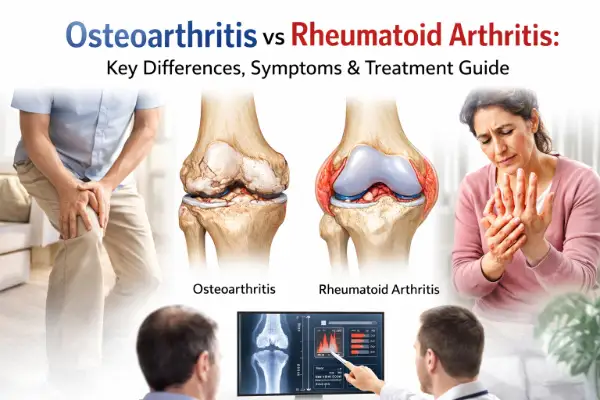
If you are dealing with persistent joint pain, it is easy to assume it is simply “arthritis” and leave it at that. However, treating all joint pain the same way can lead to delayed recovery or worse, irreversible joint damage.
Two of the most common types—Osteoarthritis (OA) and Rheumatoid Arthritis (RA)—are fundamentally different medical conditions that require entirely different treatment strategies.
The core difference between these two conditions comes down to the underlying mechanism causing the joint damage:
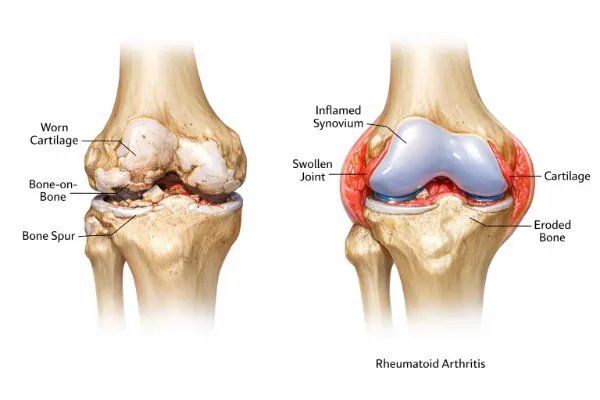
- Osteoarthritis (OA): A localized, degenerative “wear-and-tear” condition where the protective cartilage within a joint gradually breaks down over time. It typically affects specific weight-bearing joints and often appears on only one side of the body.
- Rheumatoid Arthritis (RA): A systemic, chronic autoimmune disease where the body’s immune system mistakenly attacks the healthy lining of the joints (synovium). It is a whole-body illness that typically presents symmetrically, affecting the same joints on both sides of the body simultaneously.
At-A-Glance Comparison: Understanding the Differences
To help visualize how these two conditions diverge, look at this breakdown of their distinct clinical profiles, symptoms, and diagnostic markers:
| Feature | Osteoarthritis (OA) | Rheumatoid Arthritis (RA) |
| Primary Root Cause | Mechanical “wear and tear” of joint cartilage | Autoimmune destruction of the joint lining (synovium) |
| Symmetry | Asymmetrical (e.g., affects only the right knee) | Symmetrical (e.g., affects both wrists or both hands) |
| Morning Stiffness | Brief; typically resolves in less than 30 minutes | Prolonged; frequently lasts greater than 60 minutes |
| Systemic Symptoms | None; localized strictly to the affected joints | Common; includes chronic fatigue, low-grade fever, and weight loss |
| Joint Appearance | Hard, bony enlargements (Heberden’s nodes) | Tender, warm, soft, and visibly swollen joints |
| Key Diagnostics | Clean blood work; confirmed via X-ray joint narrowing | Elevated RF, anti-CCP, CRP, and ESR inflammatory markers |
What Is Osteoarthritis?
Osteoarthritis is the most prevalent form of arthritis globally, often classified as a degenerative joint disease.
To understand OA, think of your joint cartilage like the rubber tread on a car tire. Over miles of driving, that rubber naturally thins down. In a healthy joint, cartilage acts as a slippery, shock-absorbing cushion between bones. When it breaks down, the bones begin to rub directly against each other. This physical friction results in localized pain, stiffness, and bone-on-bone spurs.
OA primarily targets high-use and weight-bearing joints, including:
- Knees and hips
- The lower back and neck (spine)
- The base of the thumb and the outermost finger joints
While aging is a major risk factor, OA is not an inevitable part of growing older. Joint injuries, repetitive occupational stress, and carrying excess body weight significantly accelerate this mechanical breakdown. However, maintaining strategic movement is crucial; incorporating specific, low-impact routines like the best exercises for knee pain over 40 can keep the surrounding muscles strong without accelerating cartilage wear.
What Is Rheumatoid Arthritis?
In stark contrast, Rheumatoid Arthritis is not caused by physical wear. It is an autoimmune disorder, meaning your body’s internal security system malfunctions.
Instead of defending the body against external viruses or bacteria, the immune system turns inward and attacks the synovium—the delicate fluid-producing membrane that lines and lubricates your joints. This continuous immune attack floods the joint capsule with inflammatory proteins, destroying both the cartilage and the underlying bone over time.
Because RA is a systemic (whole-body) disease, its footprint behaves differently:
- It typically targets smaller joints first, such as the knuckles and wrists.
- It is strictly symmetrical; if your left knuckles are inflamed, your right knuckles almost always are too.
- The chronic inflammation can expand beyond the joints, potentially affecting the heart, lungs, blood vessels, and eyes.
Because systemic inflammation drives this autoimmune response from the inside out, adopting a targeted anti-inflammatory diet for joint pain is often a critical foundational step to help calm the body’s overactive immune pathways.
💡 Dr. Preet Pal’s Clinical Perspective: “When evaluating patients in a clinical setting, the duration of morning stiffness is often the most revealing clue. If a patient tells me their joints loosen up within 15 to 20 minutes of moving around and getting breakfast, we look closely at osteoarthritis. If they are still struggling with rigid, painful stiffness an hour or two after waking up, that strongly points toward the systemic inflammation characteristic of rheumatoid arthritis.”
How Doctors Diagnose These Conditions

Because the treatments for mechanical damage and autoimmune failure are vastly different, getting a concrete medical diagnosis is critical. Doctors use a combination of physical exams, advanced imaging, and lab work to identify the culprit.
Diagnosing Osteoarthritis
For OA, blood work typically comes back entirely normal. Instead, doctors rely heavily on imaging tests:
- X-rays: Show the narrowing of space between your bones, confirming cartilage loss, and reveal any bony growths (osteophytes).
Diagnosing Rheumatoid Arthritis
For RA, blood work is the definitive tool. A physician will screen for specific systemic markers:
- Rheumatoid Factor (RF) & Anti-CCP Antibodies: Specific proteins produced by an overactive immune system.
- Erythrocyte Sedimentation Rate (ESR) & C-Reactive Protein (CRP): Blood markers that measure the overall level of active, systemic inflammation inside the body.
Disease Progression and Flare-Ups
The way these diseases progress over time follows entirely different rhythms.
Rheumatoid Arthritis is notorious for its unpredictable “flare-ups.” A patient might feel relatively stable for weeks before sudden, intense bouts of pain, swelling, and crushing fatigue hit without warning. Without early intervention, RA can cause rapid, irreversible joint deformities and physical disability within just a few years.
Osteoarthritis tends to progress slowly and predictably over many years. The pain level directly tracks physical activity—worsening after a long day of heavy lifting or walking, and improving significantly with rest.
Integrated Treatment and Lifestyle Approaches
Managing arthritis successfully requires a tailored strategy that respects the root cause of the joint damage. Building a comprehensive, daily joint pain management plan allows individuals to balance physical preservation with medical interventions safely.
| Osteoarthritis (OA) | Rheumatoid Arthritis (RA) |
| Focus: Mechanical Preservation | Focus: Immune System Regulation |
| • Low-impact movement (swimming) • Localized weight management • Targeted cartilage support | • DMARDs & Biologic therapies • Systemic anti-inflammatories • Energy conservation & rest |

Addressing Mechanical Strain (OA)
Treatment for osteoarthritis centers on reducing joint pressure and preserving remaining cartilage. Weight management is incredibly effective here—losing even a few pounds drastically minimizes the load placed on your knees and hips. Low-impact cardiovascular exercises, like swimming or cycling, keep the surrounding muscles strong enough to support the joint without adding friction damage.
While lifestyle changes are the baseline, targeted nutritional support can assist in maintaining cartilage matrix elasticity. For individuals managing the gradual wear-and-tear associated with aging joints, natural formulations containing clinically supported ingredients like Boswellia Serrata, Glucosamine, or specialized joint complexes are often utilized alongside physical therapy. You can read our detailed clinical breakdown of therapeutic choices in our detailed analysis.
Controlling the Immune Response (RA)
Because RA is driven by an overactive immune system, it cannot be managed by exercise and weight loss alone. It requires aggressive, prescription-level medical management. Rheumatologists utilize Disease-Modifying Antirheumatic Drugs (DMARDs) and advanced biologic therapies to actively suppress the malfunctioning immune response, stopping the body from attacking its own tissue.
Nutritional Support: A Deeper Look at Synovial Fluid Restoration
While lifestyle modifications and medical treatments form the bedrock of arthritis care, clinical research heavily focuses on the role of joint lubrication. In both wear-and-tear and inflammatory joint conditions, the quality of your synovial fluid—the thick, moisture-rich fluid that acts as your joint’s natural shock absorber—declines.
As we age, a key component called Hyaluronan breaks down, causing this fluid to become thin and watery, leading to increased friction and discomfort. For those seeking a targeted natural option to support joint lubrication, Joint Genesis by Biodynamix has emerged as a popular formulation designed specifically to address this issue.
🔬 Dr. Preet Pal’s Clinical Note on Synovial Lubrication: “Many joint supplements focus solely on structural components like glucosamine, but optimizing the joint’s environment requires maintaining the thickness of the synovial fluid. Ingredients like Mobilee® (a specialized hyaluronic acid matrix) and Boswellia Serrata extract have been clinically studied for their ability to support the body’s natural production of hyaluronan. By restoring the jelly-like density of the synovial fluid, you effectively re-cushion the joint spaces, which can significantly reduce mechanical friction during daily movement.”
If you are currently mapping out your long-term joint health strategy and want to see how this formulation targets fluid breakdown at the cellular level, you can read our comprehensive, ingredient-by-ingredient breakdown in our Joint Genesis Review to see if it aligns with your specific mobility goals.
When to See a Specialist
Do not ignore joints that are routinely painful, stiff, or visibly swollen. If you experience morning stiffness that lasts longer than 30 minutes, or if your joint pain is accompanied by unexplained fatigue or low-grade fevers, schedule an evaluation with a healthcare provider immediately. Catching an autoimmune condition like rheumatoid arthritis early can completely alter the course of the disease, preserving your mobility and protecting your joints for years to come.
Frequently Asked Questions
What is the main difference between osteoarthritis vs rheumatoid arthritis?
The main difference between osteoarthritis vs rheumatoid arthritis is their cause. Osteoarthritis develops due to wear and tear of joint cartilage over time, while rheumatoid arthritis is an autoimmune disease where the immune system attacks the joints. This leads to different symptoms, progression, and treatment approaches.
Which is more painful: osteoarthritis vs rheumatoid arthritis?
Both conditions can cause significant pain, but in osteoarthritis vs rheumatoid arthritis, rheumatoid arthritis often causes more intense and persistent pain due to inflammation. It can also affect multiple joints at once and cause fatigue, making it feel more severe for many people.
How can I tell if I have osteoarthritis vs rheumatoid arthritis?
You can often tell the difference between osteoarthritis vs rheumatoid arthritis by symptoms. Osteoarthritis pain worsens with activity and improves with rest, while rheumatoid arthritis causes prolonged morning stiffness, swelling, and fatigue. A doctor will confirm the diagnosis using blood tests and imaging.
Can osteoarthritis turn into rheumatoid arthritis?
No, osteoarthritis cannot turn into rheumatoid arthritis. In osteoarthritis vs rheumatoid arthritis, they are completely different conditions with different causes. However, a person can have both conditions at the same time, which may complicate diagnosis and treatment.
What is the best treatment for osteoarthritis vs rheumatoid arthritis?
Treatment differs in osteoarthritis vs rheumatoid arthritis. Osteoarthritis treatment focuses on lifestyle changes, exercise, and pain relief, while rheumatoid arthritis requires medications like DMARDs to control the immune system. Early diagnosis is important in both cases for better outcomes. While lifestyle adjustments are foundational, you can read our deep-dive on Joint Genesis to see how specific ingredients target cellular fluid loss as we age.
Verified Medical Sources
Arthritis Foundation: Comparing OA vs RA Pathophysiology
National Institute of Arthritis and Musculoskeletal and Skin Diseases (NIAMS): Osteoarthritis Clinical Overview
National Institute of Arthritis and Musculoskeletal and Skin Diseases (NIAMS): Rheumatoid Arthritis Diagnosis and Management
Centers for Disease Control and Prevention (CDC): Arthritis Types and Risk Factors
Author Bio
Jennifer Collins is a wellness researcher and natural health writer focused on adults over 40. With 3+ years of experience in digital health content, Jennifer specializes in making science-backed nutrition and lifestyle strategies easy to follow and apply.
Health Disclaimer
This content is for informational purposes only and is not intended to diagnose, treat, or cure any disease. Always consult your healthcare provider before making changes to your diet or health routine. This article may include affiliate links, which come at no extra cost to you.