

Dr. Preet Pal SB, MD
Physician specializing in diabetes, metabolic health, and joint care management. Read More About Dr. Preet Pal’s Medical Credentials & Editorial Integrity Here
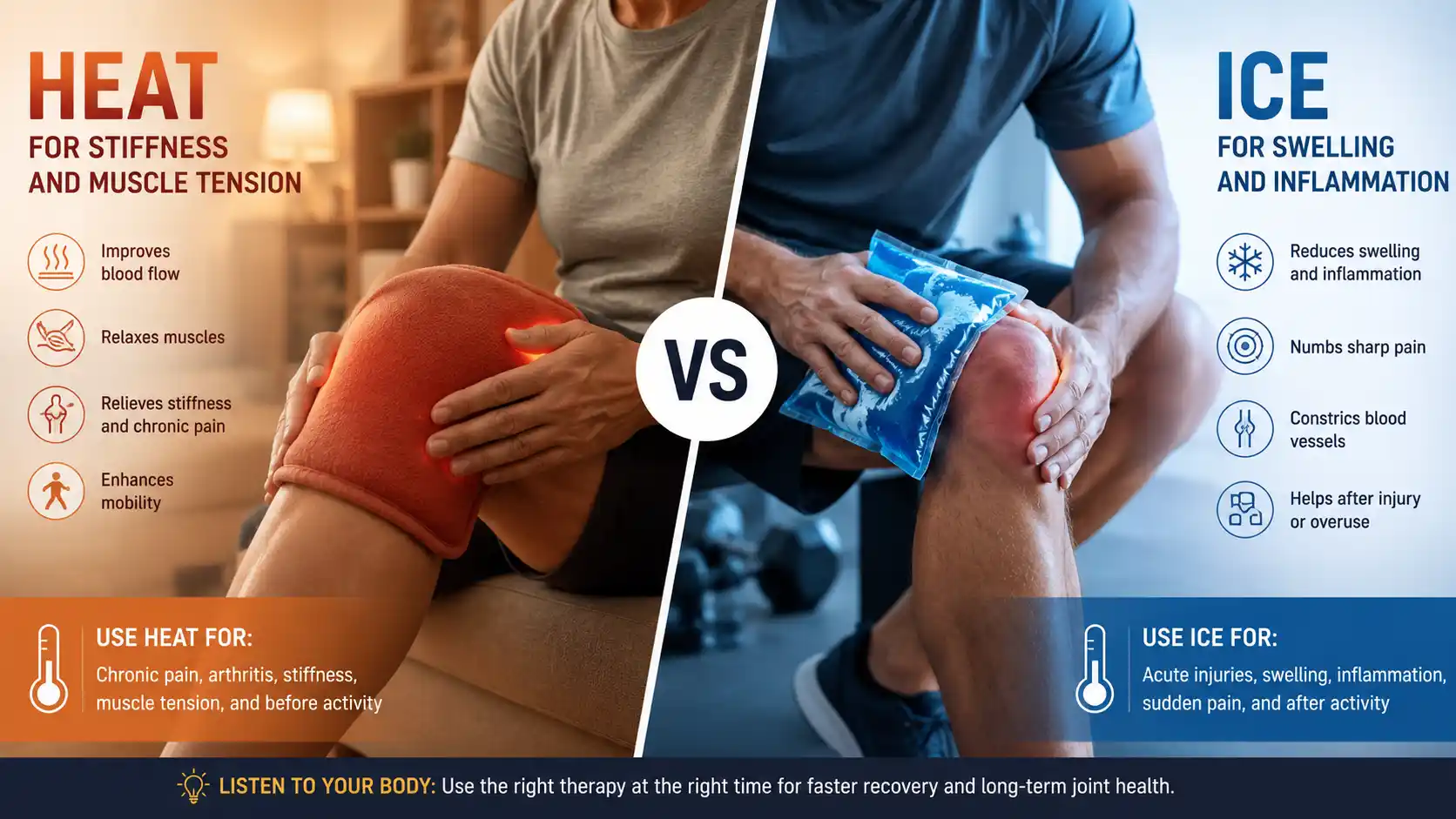
Knowing whether to reach for a heating pad or an ice pack can mean the difference between rapid recovery and prolonged discomfort. When managing joint discomfort, understanding how temperature therapies alter local circulation and tissue mechanics is critical. Deciding between heat vs ice for joint pain comes down to whether your goal is calming active inflammation or restoring flexibilty to stiff tissues.
- Constricts blood vessels
- Limits swelling & fluid buildup
- Numbs sharp nerve signaling
- Expands blood vessels
- Increases oxygen & nutrient flow
- Relaxes tight muscles & tendons
Step-by-Step Temperature Application Protocol
Evaluate Swelling and Visual Inflammation
Examine the painful joint closely. If there is visible swelling, warmth to the touch, or sharp pain from a sudden strain or sprain, your blood vessels are hyper-dilated. Apply cold therapy immediately to constrict blood vessels and limit excess fluid accumulation.
Assess Stiffness vs. Sharp Pain
If your joint feels tight, rusty, or locked—especially during early morning movement—your target is connective tissue relaxation. Apply heat therapy to increase local temperature, dilate blood vessels, and improve cartilage elasticity before physical movement.
Apply Safe 15-to-20-Minute Protocols
Limit cold applications to 15–20 minutes at a time with a towel barrier to avoid skin irritation or frostbite. Likewise, keep heat applications to 15–20 minutes at moderate temperatures to prevent skin burns or hyperthermia-induced swelling.
How Thermal Therapy Targets Joint Physiology
Temperature-based therapies operate through basic cardiovascular and neurological mechanisms. Heat and cold act as mechanical switches for local blood flow, nerve conduction speed, and connective tissue extensibility.
When you apply heat, your blood vessels dilate (vasodilation). Think of your blood vessels like a high-volume garden hose: opening the tap increases nutrient delivery and flushes out metabolic waste products like lactic acid. Furthermore, elevated tissue temperatures increase the flexibility of collagen fibers in tendons and joint capsules.
Conversely, cold therapy causes vasoconstriction—shrinking blood vessel diameter like stepping on that same hose to restrict water flow. This process drops microvascular permeability, keeping inflammatory fluid from leaking into extracellular spaces around the joint capsule. Cold also reduces the conduction velocity of pain-signaling C-fibers, providing natural neurological numbing.
When managing long-term structural pain, temperature therapy works alongside broader systemic habits. For example, maintaining a low-inflammation internal environment via a keto diet for joint health helps control baseline systemic inflammation, making localized thermal therapy significantly more effective.
Thermal Physiology: Vasodilation vs. Vasoconstriction
- Increased Blood Flow: Delivers oxygen & vital nutrients to tissue
- Metabolic Flush: Clears out accumulated cellular waste
- Tissue Extensibility: Relaxes collagen fibers in ligaments & tendons
- Restricted Blood Flow: Halts local fluid & white blood cell accumulation
- Swelling Control: Reduces capillary permeability to prevent edema
- Nerve Deactivation: Slows pain signal conduction for natural numbing
Choosing Heat or Ice for Arthritis and Chronic Pain
Determining when to use heat or ice for arthritis depends heavily on whether you are managing daily structural stiffness or an acute inflammatory flare-up.
Osteoarthritis (OA) is primarily a degenerative wear-and-tear condition. Think of articular cartilage like a car tire tread: as the protective surface thins over time, friction increases between opposing bones, leading to surrounding muscle tightness and chronic morning stiffness. For daily OA management, moist heat applied before activity warms the joint fluid, increases flexibility, and reduces movement friction.
Rheumatoid arthritis (RA), by contrast, is an autoimmune inflammatory condition where the immune system attacks the joint lining (synovium). During active RA flare-ups, joints become red, hot, and visibly swollen. Applying heat to an actively inflamed RA joint increases metabolic heat and localized swelling. Cold therapy is the clinically indicated choice during acute flare-ups to calm the immune response and numb nerve endings.
| Condition / Scenario | Primary Goal | Thermal Choice | Recommended Duration | Key Mechanism |
| Morning Osteoarthritis Stiffness | Restore flexibility & range of motion | Moist Heat | 15–20 mins (before activity) | Increases collagen elasticity & vasodilation |
| Acute Inflammatory Flare-Up (RA/Gout) | Halt fluid buildup & numb sharp pain | Cold Compress | 15 mins (every 2 hours) | Causes vasoconstriction & slows nerve signals |
| Post-Workout Joint Soreness | Calm localized overuse irritation | Cold Gel Pack | 15–20 mins | Limits micro-trauma inflammation |
| Chronic Muscle Spasms Around Joint | Relax surrounding tight muscle groups | Dry/Moist Heat | 20 mins | Relieves neuromuscular tension |
| Post-Injury (First 0–72 Hours) | Control acute trauma swelling | Ice Pack | 15 mins (3–4x daily) | Reduces capillary permeability |
Environmental Triggers: How Weather and AC Alter Joint Sensitivities
Many individuals report that environmental changes directly impact how their joints handle temperature therapies.
Barometric pressure drops during storms cause inflamed joint tissues to expand, leading to localized pressure within tight capsule structures. Understanding why joint pain gets worse during weather changes clarifies why heat is typically preferred on cold, damp days: external warmth counters barometric-induced muscle tighteness and stiffness.
Similarly, artificial indoor environments play a significant role. Prolonged exposure to cool air currents from air conditioning can cause superficial muscles to contract, tightening the soft tissues around vulnerable knee, neck, and shoulder joints. Recognizing how air conditioning impacts joint pain helps explain why short sessions of localized heat can restore comfort after spending hours in chilly office spaces.
Step-by-Step Application Protocols for Safe Relief
Incorrect application of heat or ice can cause thermal injury or rebound swelling. Follow these practical protocols to maximize therapeutic benefits safely.
Cold Therapy Protocol
- Prepare a Protective Barrier: Never apply frozen ice directly to bare skin. Wrap cold packs in a damp cloth to protect delicate dermal layers.
- Apply with Mild Elevation: Position the affected joint above heart level when possible to encourage fluid drainage while icing.
- Time Your Session: Remove cold packs after 15 to 20 minutes. Allowing skin temperature to recover prevents reflexive vasodilation (where blood surges back to warm the tissue, worsening swelling).
Heat Therapy Protocol
- Opt for Moist Heat: Warm wet towels, steam packs, or warm baths penetrate subcutaneous tissue layers faster and deeper than dry electric pads.
- Maintain Moderate Temperatures: Ensure heat source is comfortable to touch; high temperatures can cause skin burns or hyperthermia-induced tissue inflammation.
- Use Prior to Movement: Apply heat 15 minutes before stretching, walking, or physical therapy to prime connective tissues.
Contrast Therapy: The Hot-and-Cold Alternating Method
Contrast therapy involves alternating between heat and cold applications in a single session. This creates a mechanical “pumping” action within local vascular beds: heat expands the blood vessels, while cold rapidly constricts them.
This rhythmic pump speeds up lymphatic drainage and accelerates the removal of inflammatory cellular debris without increasing localized swelling.
Contrast Therapy Protocol:
- Ratio: 3 minutes of moist heat followed by 1 minute of cold therapy.
- Cycles: Repeat the cycle 3 to 4 times, always ending with cold therapy if treating a joint prone to post-activity swelling.
- Best Uses: Recovery from overuse injuries, chronic ankle or wrist tightness, and sub-acute rehabilitation phases.
Dr. Preet Pal’s Clinical Perspective
“In clinical practice, patients often overcomplicate thermal therapy or rely on it indefinitely as a standalone fix. Temperature therapy is a symptomatic tool—ice acts as a localized brake on acute inflammatory cascades, while heat acts as a lubricant to improve movement mechanics. However, thermal applications only alter surface vascular responses. Long-term joint health requires protecting structural cartilage and maintaining synovial fluid viscosity from within.”
Advanced Structural Support: Beyond Temperature Therapy
While heat and cold therapy effectively manage day-to-day symptoms, long-term joint comfort depends on the health of the joint’s internal structures. Between opposing bones lies the synovial cavity, filled with viscous synovial fluid that acts as both a shock absorber and a lubricant.
As we age, synovial fluid thins and loses its protective density—much like engine oil breaking down over thousands of miles. This reduction in cushioning increases friction on articular cartilage, triggering the chronic stiffness and inflammation that make daily thermal therapy necessary in the first place.
Targeted nutritional strategies can help support the body’s natural synovial fluid production:
To complement daily thermal routines, nutritional formulations such as Joint Genesis target synovial fluid health directly. Featuring ingredients like Mobilee®—a patented complex rich in high-molecular-weight hyaluronic acid—it helps re-hydrate thinning synovial fluid to restore its natural lubricating ability.
Re-establishing synovial fluid density helps cushion cartilage surfaces, reduce internal joint friction, and support lasting mobility alongside your regular heat and ice routines.
Verified Medical Sources
- Mayo Clinic – Acute Injury vs. Chronic Pain Management: https://www.mayoclinic.org/first-aid/first-aid-sprains/basics/art-20056620
- National Institute of Arthritis and Musculoskeletal and Skin Diseases (NIAMS): https://www.niams.nih.gov/health-topics/osteoarthritis
- Arthritis Foundation – Heat and Cold Therapy Guidelines: https://www.arthritis.org/health-wellness/healthy-living/managing-pain/pain-relief-solutions/heat-or-cold-for-arthritis-pain
- Centers for Disease Control and Prevention (CDC) – Arthritis Basics: https://www.cdc.gov/arthritis/index.html
FAQs
Can warm water exercises improve mobility better than dry heating methods?
Warm water exercises provide both gentle heat and low impact movement at the same time. This combination may improve circulation while reducing pressure on painful joints. Many people with chronic stiffness notice that movement feels easier in warm pools because buoyancy decreases stress on knees, hips, and ankles. Unlike dry heating pads, water based movement also encourages muscle activation and flexibility simultaneously.
Why does joint stiffness sometimes feel worse after sitting for long periods?
Long periods of inactivity may reduce circulation around joints and allow surrounding muscles to tighten. Cartilage also depends on movement for nutrient exchange. Heat treatment for joint stiffness before standing or stretching may help improve comfort after extended sitting. Gentle movement breaks throughout the day often prevent stiffness from becoming more severe.
Can cold therapy help after repetitive computer or desk work?
Yes. Repetitive hand, wrist, shoulder, or elbow movement may create irritation in tendons and surrounding tissues. Ice therapy for swollen joints or irritated areas may help reduce minor inflammation caused by repetitive strain. Short breaks, stretching, and ergonomic adjustments may also reduce recurring discomfort during desk work.
Does age affect how the body responds to heat and cold therapy?
Older adults may experience slower circulation, thinner skin, and reduced temperature sensitivity. Because of this, they should use moderate temperatures and shorter sessions. Heat therapy for joint stiffness may still improve comfort, but careful monitoring is important to avoid burns or skin irritation.
Why can cold therapy feel uncomfortable at first but soothing later?
Cold exposure initially triggers a sharp sensation because nerves react quickly to temperature changes. After several minutes, nerve activity slows and tissues begin to feel numb, which may reduce discomfort. This delayed soothing effect is one reason cold application for swollen joints is commonly used after injury.
Can alternating temperatures improve exercise recovery?
Some athletes use alternating warm and cold therapy after intense training because changing temperatures may stimulate circulation while limiting inflammation. Understanding when to use heat or ice for pain during recovery depends on whether stiffness or swelling is the dominant symptom after activity.
Are there situations where neither heat nor ice should be used?
Yes. Open wounds, severe circulation problems, skin infections, and unexplained swelling should be evaluated before temperature therapy is applied. Persistent symptoms without a clear cause may require medical assessment to rule out underlying joint disease or nerve conditions.
Author Bio
Jennifer Collins is a wellness researcher and natural health writer focused on adults over 40. With 3+ years of experience in digital health content, Jennifer specializes in making science-backed nutrition and lifestyle strategies easy to follow and apply.
Health Disclaimer
This content is for informational purposes only and is not intended to diagnose, treat, or cure any disease. Always consult your healthcare provider before making changes to your diet or health