

Hip and leg pain can feel confusing. One day it’s a dull ache, the next day it shoots down your leg like a lightning bolt. Most people assume it’s sciatica. But that assumption can lead you down the wrong treatment path.
Here’s the reality: many cases of “sciatica” are actually piriformis syndrome.
When you compare piriformis syndrome vs sciatica, the symptoms overlap a lot. That’s why even active people and desk workers misread the signals their body sends.
This guide breaks it down in a clear, human way—so you can understand what’s really happening and what to do next.
Table of Contents
What Is Sciatica?
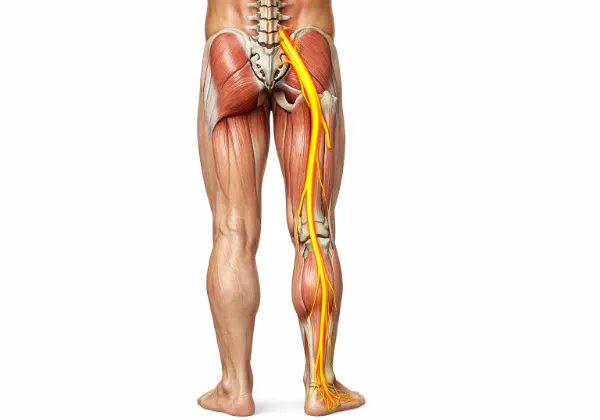
Sciatica describes pain that travels along the sciatic nerve, the longest nerve in your body. It starts in your lower back and runs through your hips, buttocks, and down each leg.
Important detail: sciatica is not a diagnosis—it’s a symptom.
Something compresses or irritates the nerve. That “something” usually comes from the spine.
Common Causes of Sciatica
- Herniated or bulging disc
- Spinal stenosis (narrowing of the spine)
- Degenerative disc disease
- Spondylolisthesis (vertebra slipping out of place)
Sciatica Symptoms
You’ll usually notice:
- Sharp or burning pain from lower back to leg
- Tingling or “pins and needles” sensation
- Numbness in parts of the leg or foot
- Muscle weakness
Sciatica pain often follows a clear path. It doesn’t wander—it travels in a line. That’s a big clue.
Many people notice similar discomfort when walking uphill, especially with muscle-related issues—this article on Hip Pain When Walking Uphill? Causes & Quick Relief breaks it down clearly.
What Is Piriformis Syndrome?
The piriformis is a small muscle deep in your glutes. It helps rotate your hip and stabilize your pelvis when you walk.
Now here’s where things get interesting.
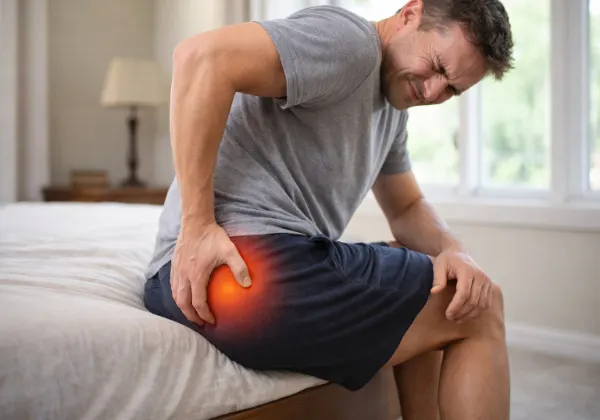
The sciatic nerve runs very close to this muscle. In some people, it even passes through it. When the piriformis tightens or spasms, it can press on the nerve.
That’s piriformis syndrome.
Common Causes of Piriformis Syndrome
- Prolonged sitting (yes, your chair can be the villain)
- Overuse from running or climbing stairs
- Poor posture
- Muscle imbalance or weak glutes
Piriformis Syndrome Symptoms
- Deep, aching pain in the buttock
- Pain that worsens when sitting
- Discomfort when climbing stairs or walking uphill
- Pain that may radiate down the leg
Unlike sciatica, the pain often feels more localized at first. It starts in the buttock before spreading.
Piriformis Syndrome vs Sciatica: Key Differences
Understanding piriformis syndrome vs sciatica comes down to identifying the source of pain.
1. Where the Pain Starts
- Sciatica → Lower back
- Piriformis syndrome → Deep buttock
If your pain begins in your back, sciatica is more likely. If it starts in your glutes, piriformis syndrome becomes the main suspect.
2. Pain Pattern
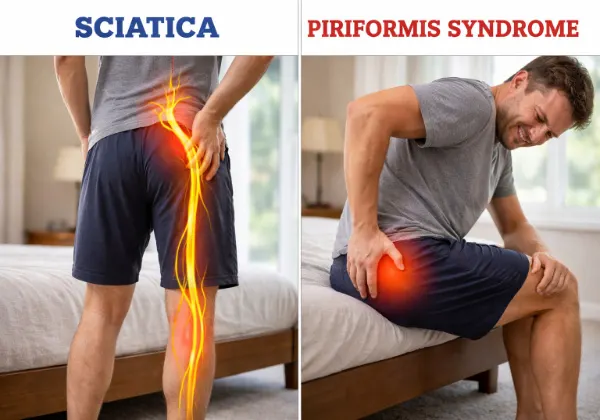
- Sciatica → Travels in a straight nerve path
- Piriformis → Can feel more scattered or triggered by movement
Sciatica behaves like a highway. Piriformis syndrome acts more like city traffic—less predictable.
3. Sitting vs Movement
- Sciatica → Sitting often worsens pain
- Piriformis → Sitting almost always worsens pain
If sitting feels unbearable, piriformis syndrome often plays a role.
4. Back Pain Presence
- Sciatica → Usually includes lower back pain
- Piriformis → Rarely includes back pain
No back pain? That’s a strong hint you’re not dealing with classic sciatica.
Why People Confuse Piriformis Syndrome vs Sciatica
Here’s the honest truth—your body doesn’t label pain.
Both conditions irritate the same nerve. That creates similar sensations:
- Shooting pain
- Tingling
- Radiating discomfort
Doctors often use imaging like MRI to confirm spinal issues. But piriformis syndrome doesn’t show up clearly on scans. That makes diagnosis trickier.
So when people search for piriformis syndrome vs sciatica, they’re usually stuck in that gray zone.
Simple Self-Tests to Spot the Difference
You don’t need a lab to start figuring things out. A few simple movements can give strong clues.
The Sitting Test
Sit for 20–30 minutes.
- Pain increases sharply → Likely piriformis syndrome
- Mild discomfort or numbness → Could be sciatica
The Stretch Test
Try a gentle figure-4 stretch.
- Pain improves → Piriformis syndrome likely
- Pain worsens or shoots down leg → Sciatica more likely
The Back Movement Test
Bend forward slowly.
- Pain increases → Sciatica
- No major change → Piriformis syndrome
These aren’t perfect tests, but they help you narrow it down.
Treatment: Why the Difference Matters
This is where piriformis syndrome vs sciatica really matters.
Treating the wrong condition can delay recovery—or make it worse.
Treating Sciatica
You need to address the spine.
- Physical therapy focused on spinal alignment
- Core strengthening
- Anti-inflammatory medications
- In severe cases, injections or surgery
Stretching your glutes alone won’t fix a disc problem.
Treating Piriformis Syndrome
You need to relax and strengthen the muscle.
- Piriformis stretches
- Glute strengthening exercises
- Foam rolling
- Reducing prolonged sitting
No spine issue here—so back-focused treatments won’t help much.
When to See a Doctor
Don’t try to “tough it out” if you notice:
- Severe or worsening pain
- Loss of bladder or bowel control
- Significant leg weakness
- Pain lasting more than a few weeks
These signs need proper medical evaluation.
Prevention Tips That Actually Work
You don’t need a complicated routine. Simple habits make a big difference.
- Move every 30–60 minutes if you sit a lot
- Strengthen your glutes and core
- Maintain good posture
- Warm up before exercise
- Avoid overtraining without recovery
Consistency beats intensity here.
Frequently Asked Questions
What is the main difference between piriformis syndrome vs sciatica?
The main difference between piriformis syndrome vs sciatica lies in the source of the pain. Sciatica starts in the lower spine due to nerve compression, often from a herniated disc. Piriformis syndrome begins in the piriformis muscle in the buttock, which irritates the sciatic nerve. Both cause similar symptoms, but the origin changes the treatment approach.
How can I tell if I have piriformis syndrome or sciatica at home?
To identify piriformis syndrome vs sciatica at home, pay attention to where your pain starts. If it begins in your lower back and travels down your leg, it’s likely sciatica. If it starts deep in your buttock and worsens when sitting, piriformis syndrome is more likely. Simple stretches like the figure-4 stretch can also help differentiate the two.
Can piriformis syndrome turn into sciatica?
Piriformis syndrome does not turn into sciatica, but it can mimic it. In the debate of piriformis syndrome vs sciatica, both conditions irritate the same sciatic nerve. That’s why piriformis syndrome is often called “pseudo-sciatica,” even though the root cause is different.
Which is more serious: piriformis syndrome vs sciatica?
When comparing piriformis syndrome vs sciatica, sciatica is generally considered more serious because it often involves spinal issues like disc herniation. Piriformis syndrome is usually muscle-related and easier to manage with stretching and strengthening exercises, though it can still cause significant discomfort.
What is the fastest way to relieve piriformis syndrome vs sciatica pain?
The fastest relief for piriformis syndrome vs sciatica depends on the cause. For piriformis syndrome, stretching, foam rolling, and reducing sitting time can quickly ease symptoms. For sciatica, you may need spinal-focused treatments like physical therapy, posture correction, and anti-inflammatory support to reduce nerve compression.
Final Thoughts on Piriformis Syndrome vs Sciatica
If there’s one thing to remember, it’s this:
Same nerve, different cause.
Sciatica starts in the spine. Piriformis syndrome starts in the muscle. The symptoms may overlap, but the solution depends on identifying the source.
So next time your leg pain shows up uninvited, don’t guess. Observe where it starts, how it behaves, and what triggers it.
Your body gives clues. You just need to read them right.
Sources
- National Institute of Neurological Disorders and Stroke (NINDS)
- American Academy of Orthopaedic Surgeons (AAOS)
- Cleveland Clinic – Piriformis Syndrome
- Harvard Health Publishing – Sciatica Overview
- Spine-health – Sciatica Symptoms, Causes, and Treatments
Author Bio
Jennifer Collins is a wellness researcher and natural health writer focused on adults over 40. With 3+ years of experience in digital health content, Jennifer specializes in making science-backed nutrition and lifestyle strategies easy to follow and apply.
Health Disclaimer
This content is for informational purposes only and is not intended to diagnose, treat, or cure any disease. Always consult your healthcare provider before making changes to your diet or health routine. This article may include affiliate links, which come at no extra cost to you.