


Dr. Preet Pal SB, MD
Physician specializing in diabetes, metabolic health, and joint care management. Read More About Dr. Preet Pal’s Medical Credentials & Editorial Integrity Here
Waking up with stiff, achy joints can make simply sitting up feel like an uphill battle. Performing targeted warm up exercises before getting out of bed helps prime your body by increasing body temperature, pumping synovial fluid into dry joints, and restoring muscle flexibility before your feet even touch the floor.
During overnight sleep, lack of movement causes joint fluid to thicken and metabolic waste to accumulate in soft tissues. Think of your joints like a car engine on a freezing winter morning: turning the key and immediately accelerating creates intense engine strain, but letting the motor idle for a few minutes circulates essential oil throughout the system. Gentle morning movement works the same way for your cartilage and synovial membrane.
How Pre-Bed Exit Warm-Ups Protect Your Joints
Perform Bed-Anchored Ankle Pumps
Lying on your back, slowly point your toes away from you and then flex them back toward your shins. Complete 15 to 20 continuous repetitions to pump pooled venous blood back toward the heart and lubricate the ankle joints.
Execute Gentle Knee-to-Chest Hugs
Pull one knee at a time gently toward your chest while keeping the opposite leg flat on the mattress. Hold for 5 to 10 seconds per side to decompress lower back vertebrae and stretch tight gluteal muscles.
Engage in Supine Pelvic Tilts
Bend both knees with feet flat on the bed, press your lower back firmly into the mattress, and hold for 5 seconds before releasing. Repeat 10 times to gently wake up deep core stabilizers before bearing weight.
Activate Gentle Leg Extensions
While sitting on the edge of the bed or lying flat, slowly straighten one leg at a time, holding the top extension for 3 seconds to push synovial fluid through the knee capsule.
Why Morning Stiffness Happens: The Biology of Sleep Immobility
To understand why exercises when you get out of bed are so effective, it helps to examine what occurs biologically during six to eight hours of rest.
When you lie still for extended periods, your cartilage acts like a dry sponge. Without movement, synovial fluid—the viscous liquid that lubricates your joint capsule—drains out of the articular cartilage matrix. Concurrently, systemic body temperature drops slightly, causing ligaments and tendons to become stiff and rigid.
Dr. Preet Pal’s Clinical Perspective
“Patients frequently tell me their joint pain is worst in the first 20 minutes after waking. This is not structural joint destruction happening overnight; it is the physical outcome of fluid stasis. When you move gently in bed before standing, you trigger the ‘sponge effect’—forcing thick, static joint fluid to recirculate, rehydrating articular cartilage and reducing mechanical friction by up to 60% before you bear weight.”
Comparing Morning Joint Warm-Up Techniques
Not all movements are created equal when your joints are cold. The table below compares common morning movement strategies based on safety, joint impact, and clinical purpose.
| Warm-Up Exercise | Target Area | Joint Load Level | Primary Clinical Benefit |
| Ankle Pumps & Circles | Lower legs & feet | Zero-Load (Supine) | Promotes venous return & reduces foot stiffness |
| Pelvic Tilts | Lumbar spine & pelvis | Zero-Load (Supine) | Decompresses lower back & activates core stability |
| Seated Heel Slides | Knees & hips | Low-Load (Supported) | Lubricates patellofemoral joint space safely |
| Standing Toe Touches | Hamstrings & spine | High-Load (Gravitational) | Not Recommended: Causes spinal compression when cold |
4 Essential Bed Warm-Ups to Prevent Joint Strain
Integrating gentle mobility routines into your morning habit stack protects aging cartilage and improves balance. For long-term functional independence, combining these movements with broader mobility exercises for seniors ensures your joints stay resilient throughout the day.
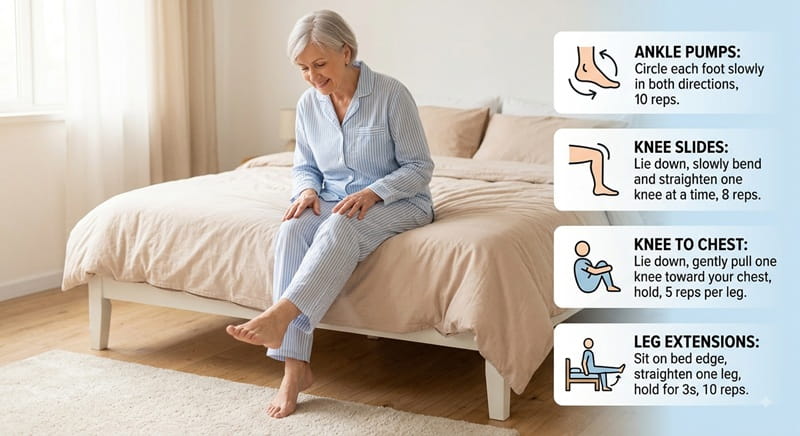
1. Supine Ankle Pumps and Wrist Rotations
Start before removing your covers. Flex and extend your ankles up and down, then roll them in smooth circles. Perform the same movement with your wrists. This instantly drives circulation to distal extremities.
2. Knee-to-Chest Lumbar Decompression
Lying flat on your back, draw one knee gently toward your torso, holding behind the thigh rather than the top of the shin to avoid compressing the knee joint. Repeat 5 times per side.
3. Seated Edge-of-Bed Leg Extensions
Sit up slowly on the edge of your mattress with your feet dangling. Slowly extend one calf until the leg is straight, squeeze the quadriceps for 3 seconds, and lower it. This directly supports knee joint health, working in tandem with targeted knee strengthening exercises for seniors.
4. Trunk Rotations and Shoulder Rolls
While seated on the edge of the bed, place your hands on your hips and gently rotate your upper torso side to side. Finish with 10 backward shoulder rolls to open the chest cavity and reduce neck tension.
Building these habits into a structured joint pain management plan helps break the cycle of chronic morning flare-ups and prevents accidental falls caused by sudden weight-bearing on stiff limbs.
Clinical Spotlight: Fast-Acting Topical Relief for Severe Morning Stiffness
While gentle bed exercises effectively circulate synovial fluid from within, severe osteoarthritis or rheumatoid flare-ups can make initial movements painful. Applying a targeted topical analgesic right at your bedside can help soothe raw nerve endings so you can comfortably perform your morning warm-ups.
For patients needing targeted relief, Balmorex Pro serves as an exceptional topical pain relief cream for morning stiffness and arthritis. Formulated with clinical-grade natural anti-inflammatory agents—including Arnica Montana, MSM, and Hemp Extract—it quickly penetrates deep into joint tissue without leaving a greasy residue.
Applying Balmorex Pro to knees, hands, or lower back 5 minutes before beginning your in-bed exercises helps numb localized discomfort, enabling smoother joint articulation and faster morning recovery.
When to Consult a Physician or Physical Therapist
While morning stiffness lasting 15 to 30 minutes is common with wear-and-tear arthritis, certain symptoms require formal medical evaluation. Contact your healthcare provider if you experience:
- Morning stiffness that persists for longer than 60 minutes continuously.
- Visible joint swelling, skin redness, or heat in the knee, wrist, or ankle joints.
- Sharp, severe pain when transitioning from lying to sitting.
- Numbness, tingling, or radiating pain shooting down your legs upon standing.
Verified Medical Sources
- Centers for Disease Control and Prevention (CDC): Physical Activity for Arthritis Management
- National Institute of Arthritis and Musculoskeletal and Skin Diseases (NIAMS): Living With Arthritis: Daily Care & Exercise Guide
- Mayo Clinic: Osteoarthritis Symptoms, Diagnosis, and Exercise Recommendations
- Arthritis Foundation: Morning Stiffness Relievers and In-Bed Exercises
Frequently Asked Questions
What are the best warm up exercises before getting out of bed?
The best warm up exercises before getting out of bed include full body stretch, knee-to-chest stretch, spinal twists, ankle pumps, and glute bridges. These movements gently activate your muscles, improve circulation, and reduce morning stiffness without putting stress on your body.
Do warm up exercises before getting out of bed really help with stiffness?
Yes, warm up exercises before getting out of bed help reduce stiffness by increasing blood flow and lubricating your joints after hours of inactivity. Regular practice can improve flexibility, reduce discomfort, and make your first movements of the day feel easier.
How long should I do warm up exercises before getting out of bed?
You only need about 5 minutes to perform effective warm up exercises before getting out of bed. A short routine done consistently every morning can significantly improve mobility and reduce stiffness over time.
Are warm up exercises before getting out of bed safe for people over 40?
Warm up exercises before getting out of bed are generally safe and highly beneficial for people over 40. They help maintain joint health, improve flexibility, and reduce the risk of injury. However, those with existing medical conditions should consult a healthcare professional.
Can warm up exercises before getting out of bed prevent back pain?
Warm up exercises before getting out of bed can help prevent back pain by activating core muscles, improving spinal mobility, and reducing stiffness. While they are not a cure, they can play a key role in supporting a healthier, pain-free back.
Author Bio
Jennifer Collins is a wellness researcher and natural health writer focused on adults over 40. With 3+ years of experience in digital health content, Jennifer specializes in making science-backed nutrition and lifestyle strategies easy to follow and apply.
Health Disclaimer
This content is for informational purposes only and is not intended to diagnose, treat, or cure any disease. Always consult your healthcare provider before making changes to your diet or health routine. This article may include affiliate links, which come at no extra cost to you.